Google DeepMind's AI Breakthrough in Hurricane Forecasting
Quick Summary
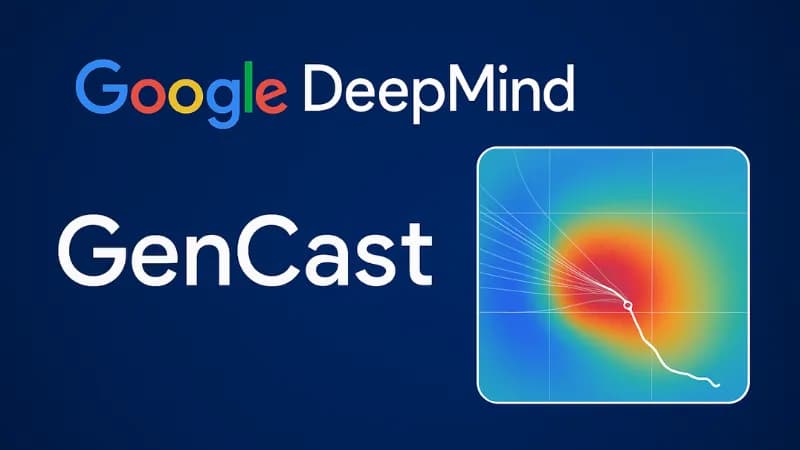
Google DeepMind has announced GenCast, a breakthrough AI system approved by the National Hurricane Center for hurricane forecasting beginning in 2025. GenCast promises faster and more accurate forecasts than traditional models, improving predicted storm locations by more than 140 km and producing a 15-day forecast in just one minute. The system represents an important step toward reducing hurricane damage and strengthening the response to climate change.
Forecasting Hurricanes and Tropical Depressions: A Decades-Long Challenge
For weather forecasting, Google DeepMind also has the GraphCast model, capable of forecasting weather for 10 days with greater accuracy than HRES (Europe's gold-standard weather simulation system) across 99.7% of tested variables in the troposphere, and has been directly tested by ECMWF on their website.
As for forecasting various types of hurricanes and tropical depressions, it has always been one of the most complex forecasts, posing the greatest challenge to the meteorological industry. Traditional forecasting models are all based on physical equations and supercomputers; even AI weather forecasting models still encounter clear limitations.
Especially when encountering extreme and rare weather phenomena, also known as “black swan” events – most current models struggle to identify and predict them due to a lack of corresponding historical training data. Over the past 50 years, tropical cyclones have caused over 1,400 billion USD in economic losses globally – a figure that demonstrates the urgent need for faster and more accurate forecasting technologies.
GenCast and Weather Lab: DeepMind's AI Tools for Hurricane Forecasting
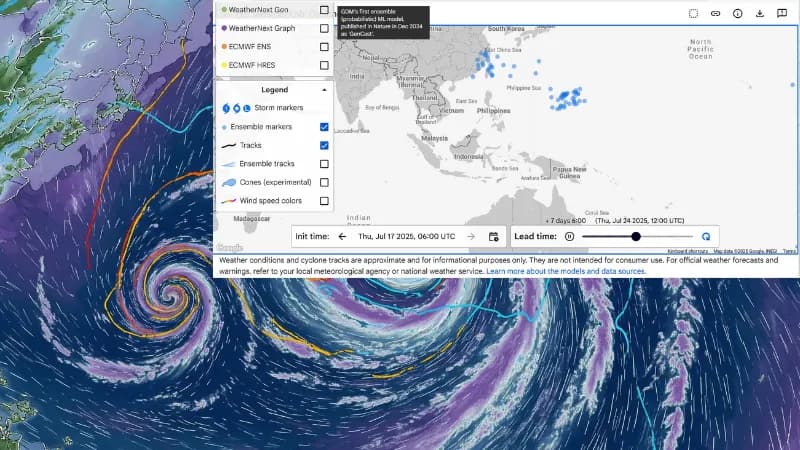
To address this challenge, Google DeepMind has launched a new AI system called WeatherNext Gen (abbreviated as GenCast), deployed through the Weather Lab platform. This model not only predicts the path but also simulates the intensity of storms for up to 15 days, with better resolution and speed than traditional physical models.
Key GenCast Capabilities
- Superior Accuracy: In testing, GenCast predicted storm locations with up to 140 km greater accuracy than ENS (Europe's leading ensemble model). More notably, it also surpassed NOAA's HAFS system (U.S. National Oceanic and Atmospheric Administration) in predicting intensity – an inherent weakness of previous AI models.
- Ultra-Fast Speed: While traditional models require hours of computation on supercomputers, GenCast can produce a 15-day forecast in just one minute on Google Cloud's TPU chips. As a result, the system fully meets the NHC's requirement for forecasts to be available within 6.5 hours from the data collection time.
-
Intelligent Deep Learning Method: GenCast is trained based on:
- Global climate reanalysis data, with millions of observations over decades.
- A detailed dataset of nearly 5,000 storms over 45 years, including IBTrACS data sources.
This is a Conditional Diffusion Model AI, integrating a Functional Generative Network that allows for probabilistic simulation, learning from past data, and handling uncertainty in forecasts.
From Research to Operational Forecasting at the NHC
What's special is that the U.S. National Hurricane Center (NHC) has officially integrated this AI model into its operational evaluation process, starting from the 2025 Atlantic hurricane season.
Two Key Advances
- Real-time Integration: Forecasts from GenCast will run in parallel with traditional physical models within the workflow of forecasters at the NHC.
- Field Evidence: In recent events such as Hurricanes Otis (2023) and Beryl (2024), the AI system accurately predicted the rapid intensification of the storms – something many traditional models missed. If deployed earlier, warnings could have been issued hours in advance.
The Future: AI Augments Rather Than Replaces Forecasters
Google DeepMind emphasizes that GenCast remains a research tool and does not replace official meteorological agencies; therefore, all information on Weather Lab, according to Google, is still for reference only.
However, the clear goal is for AI to supplement and enhance the accuracy of existing systems, especially in situations where response time is a critical factor, and the future development direction will be a hybrid model combining AI and physics to ensure scientifically sound results.
AI as an Ally Against Climate Change and Natural Disasters
More accurate weather forecasting is not just a scientific issue but also a matter of life and death for millions of people. By integrating AI into meteorology, we are witnessing a revolution in how humans understand and respond to nature.
GenCast is a testament to the potential of artificial intelligence not only in predicting the future but also in protecting people from the impacts of storms.