Milla Jovovich is building a new Red Queen with MemPalace
Quick Summary
Milla Jovovich, star of the Resident Evil series, is bringing the supercomputer Red Queen to life through her AI project MemPalace, a system that gives artificial intelligence permanent memory with complete privacy and zero cloud dependency.
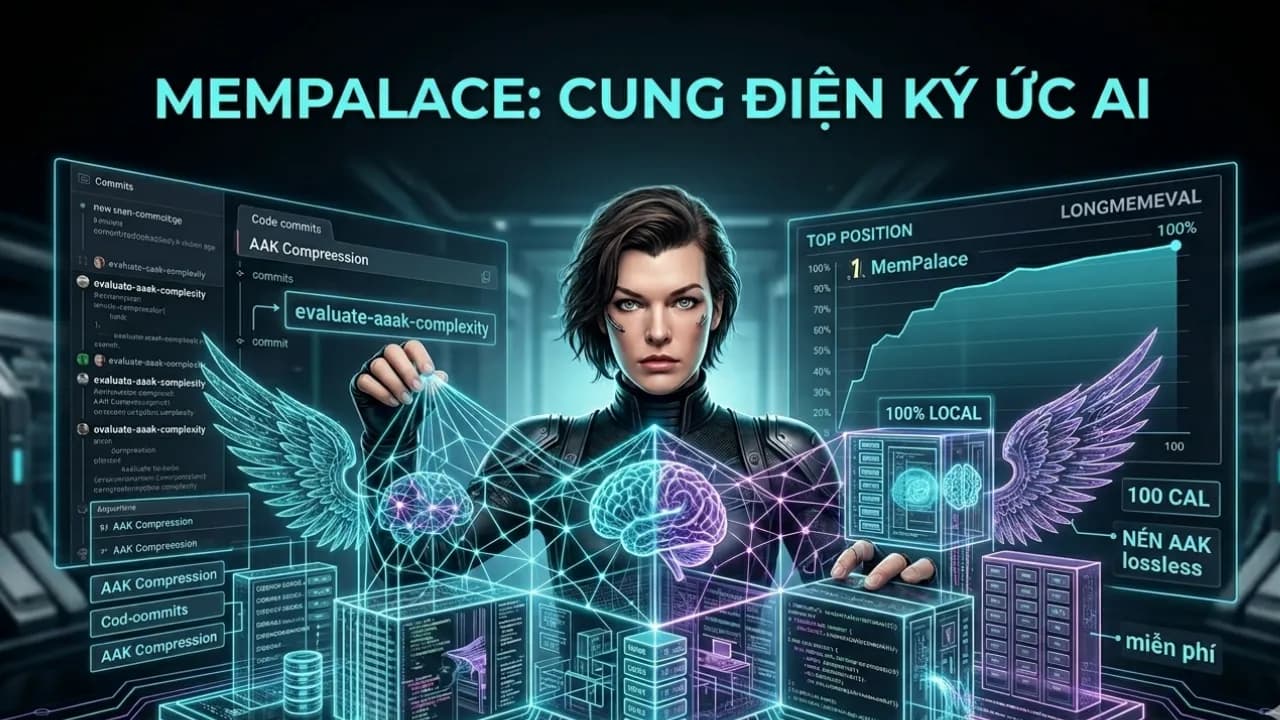
Milla Jovovich, the face anyone who has watched the Resident Evil series will instantly recognize as Alice, and Leeloo from The Fifth Element, has surprised the AI community with the launch of MemPalace, a free, open-source AI memory system that has achieved the highest score ever recorded on the LongMemEval benchmark. The community has been joking that she never quite left the role, apparently still working for the Umbrella Corporation to build a new Red Queen.
The project was developed in collaboration with programmer Ben Sigman, drawing inspiration from the ancient Greek technique of the Memory Palace. Rather than simply summarizing or storing information in disconnected fragments, MemPalace builds a structured virtual palace with clearly defined wings, corridors, rooms, closets, and drawers to organize entire conversations, ideas, and knowledge in a logical and searchable way.
This shows just how vast the potential of AI has become when it enables actors, professors, and doctors alike to build powerful AI platforms that are genuinely usable in real work.

Why did MemPalace catch everyone off guard?
The first surprise was that the GitHub account is genuinely hers, which anyone can verify at https://github.com/milla-jovovich/. The second surprise is that Milla Jovovich is not participating in MemPalace as a celebrity endorser. She is committing code from that verified GitHub account, and for anyone who doubts it, the evidence is right there in this commit.
On the purely technical side, MemPalace currently offers several notable advantages:
- Fully local: Runs entirely on your personal machine with no cloud required, no data sent anywhere, strong privacy, and zero ongoing cost.
- 100% information retention: No summarization means no loss of important detail.
- Easy integration: Supports multiple AI models including Claude, ChatGPT, Gemini, and Llama, and can import data from chat history, Slack, and other sources.
- Impressive benchmark results: Achieved the highest score, approaching a perfect score, on LongMemEval, a test measuring long-term recall, multi-step retrieval, and knowledge updates over time.
MemPalace is not just a storage tool. It is a new approach to helping AI "remember like a human," organizing information spatially rather than relying purely on vector search or summarization.
AAK technology: the secret language that compresses memory
One standout feature in MemPalace is AAK technology, short for the experimental Abbreviation-As-A-Key system. This is an intelligent compression layer that functions like a shorthand language any LLM can read without a separate decoder.
What is AAK and is it easy to understand?
Imagine a thick notebook filled with months of conversation records. Instead of keeping every word intact, which consumes enormous storage and token budget, AAK compresses repeated information intelligently:
- It uses entity codes for frequently mentioned people, tools, or concepts.
- It adds structural markers to preserve relationships between ideas.
- It shortens sentences while retaining the core meaning.
A simple example: Instead of repeating "The user prefers PostgreSQL because it is stable, open-source, and high-performance," AAK compresses this to something like "User prefers Postgres [reason: stable, open-source, high perf]," saving a significant number of tokens in the process.
The advantages of AAK
- Strong compression, up to 30x in some cases, making it possible to fit months of data into a context window without hitting the limit.
- Still directly readable by any AI model without a special decoder.
- Fully local with no cloud dependency.
Current limitations of AAK
This is an experimental feature. On the LongMemEval benchmark, the AAK-compressed version sometimes scores lower than the raw uncompressed mode due to its lossy nature, meaning some information is lost in compression. The team is actively working on improvements.
In short, AAK is like writing "concise but complete" personal notes, helping AI read faster and retain more without requiring a massive model to do it.
Compared to Mem0 and Zep, the current leaders in AI memory
Mem0 and Zep are the two most widely used AI memory frameworks for agents and chat applications. They each solve the "AI forgets everything" problem in different ways.
Mem0, like a personalized companion
- How it works: Automatically extracts important information from conversations and stores it in a vector database with an optional knowledge graph layer.
- Strengths: Easy to use, token-efficient, well suited for long-term personalization.
- Weaknesses: Can miss details if summarization is too aggressive. LongMemEval benchmark score is approximately 49%.
Zep, like a professional historian
- How it works: Builds a temporal knowledge graph where every event is anchored to a specific point in time.
- Strengths: Strong at complex queries and tracking how things change over time. Benchmark score approximately 64%.
- Weaknesses: Building and maintaining the graph requires more time and computational resources.
Quick comparison table
| Criteria | Mem0 | Zep | MemPalace (Milla Jovovich) |
|---|---|---|---|
| Approach | Personalization-focused, token-efficient | Temporal, deep historical tracking | Memory Palace, spatial organization |
| Storage method | Vector database with optional graph | Temporal knowledge graph | Full data retention with room structure and AAK compression |
| Benchmark score | ~49% | ~64% | Highest recorded, near 100% in some configurations |
| Cost and resources | Low | Medium to high | Very low, runs locally and free |
| Ease of use | Very easy | Moderate | Easy, single installation command |
| Privacy | Good, self-hosting available | Good, cloud option available | Excellent, 100% local |
What MemPalace brings to the AI community
Milla Jovovich's MemPalace brings a fresh perspective to AI memory research, demonstrating that you don't need a massive model or expensive cloud infrastructure to achieve outstanding results. A creative idea drawn from ancient technique, combined with modern engineering, can outperform systems built with far greater resources.
If you're building an AI agent or simply want your personal AI to remember things reliably over time, MemPalace is worth trying today since it installs via pip and runs entirely locally. This isn't just another tool. It's a meaningful step toward making AI more trustworthy and genuinely useful for the people who rely on it.