Microsoft launches 7 new AI models to challenge OpenAI
Quick Summary
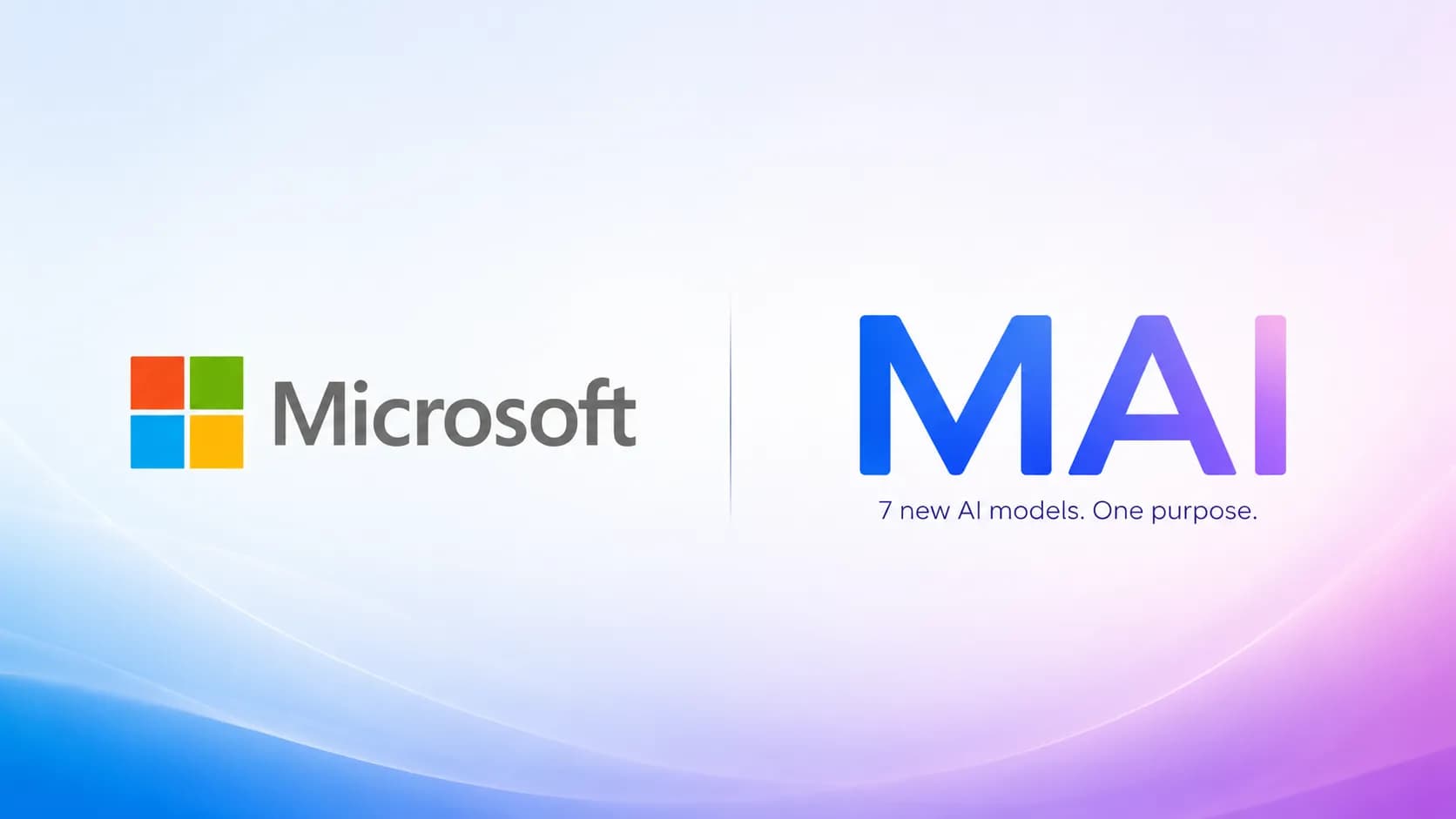
At Build 2026, Microsoft officially unveiled seven new AI models under the MAI family, covering reasoning, coding, image generation, and voice. The standout is MAI-Thinking-1 with 35 billion parameters, trained entirely on clean data without distillation from third-party models. Additionally, MAI-Code-1-Flash will integrate directly into GitHub Copilot and Visual Studio Code to empower developers. The MAI-Image-2.5, MAI-Voice-2, and MAI-Transcribe-1.5 models fill the remaining multimedia gaps in Microsoft's AI portfolio. This is a clear signal that the software giant aims to reduce its reliance on OpenAI and build a self-contained AI ecosystem on top of Azure, Copilot, and Microsoft Foundry. By achieving technology autonomy, Microsoft not only optimizes operational costs for Copilot services but also provides enterprise customers with highly customizable, secure AI solutions directly integrated into their existing Azure infrastructure.
Microsoft just dropped seven new AI models at Build 2026, with MAI-Thinking-1 boasting 35 billion active parameters and trained entirely on clean data. For the first time, the software giant is openly challenging the position of its own strategic partner, OpenAI, on the AI model battlefield.
MAI-Thinking-1 and Microsoft's reasoning ambitions
The centerpiece of Build 2026 was MAI-Thinking-1, Microsoft's first reasoning AI model developed entirely in-house. With approximately 35 billion active parameters, the model is designed to handle multi-step reasoning tasks, work with long contexts, and support complex coding, all at a lower cost than many large-scale AI models currently available.
The most notable claim is that Microsoft trained MAI-Thinking-1 on clean data without using distillation from third-party AI models. In other words, this is a clear statement that Microsoft has the independent AI research capability to build competitive models without "borrowing" knowledge from GPT or any other model.
According to Microsoft's published evaluations, MAI-Thinking-1 achieves competitive performance on coding benchmarks and is rated on par with many leading AI models in blind evaluation tests. The 35-billion parameter count also signals that Microsoft is prioritizing efficiency over raw scale, as many competitor models have significantly more parameters but may not necessarily deliver better output quality.
From coding to voice: a complete AI ecosystem
Beyond reasoning, Microsoft introduced six additional AI models to build a complete AI ecosystem serving both individual users and enterprises. From coding and image generation to voice synthesis, every piece of the puzzle now has a dedicated model.
Smarter coding with MAI-Code-1-Flash
For developers, MAI-Code-1-Flash is significant news. This model specializes in code generation and software development support, optimized for real-world programming tasks. More importantly, it will be integrated directly into GitHub Copilot and Visual Studio Code, two tools used daily by millions of developers. This means code suggestions and automated coding experiences will be significantly upgraded within familiar development environments.
Images and voice: the missing pieces
In the creative content space, Microsoft announced MAI-Image-2.5 alongside MAI-Image-2.5-Flash. These are next-generation image creation and editing models, with the Flash version optimized for fast response times, making it suitable for real-time applications like live photo editing or on-demand illustration generation.
In the audio domain, Microsoft introduced two important models:
- MAI-Voice-2 with more natural voice synthesis capabilities and support for additional languages
- MAI-Transcribe-1.5 for speech-to-text conversion with significantly faster processing speeds than the previous generation
Additionally, Microsoft has developed optimized variants specifically for the Microsoft Foundry platform, helping enterprises easily build and deploy their own AI applications.
The strategy to reduce OpenAI dependence
Where Microsoft was previously seen mainly as an infrastructure partner and deployment platform for OpenAI, Build 2026 shows the company is steadily acquiring all the essential components of a full AI ecosystem. Microsoft now has its own reasoning model, coding model, image generation model, voice synthesis model, and speech recognition model, all connected directly to the Azure, Copilot, and Microsoft Foundry ecosystem.
This strategy gives Microsoft greater autonomy in developing core technology while reducing risk from dependence on external partners. More specifically, owning proprietary AI models allows Microsoft to control its product roadmap, optimize operational costs, and customize models for specific service needs without waiting for or negotiating with third parties.
Where does the AI model race go from here?
The simultaneous launch of seven new AI models shows Microsoft is investing heavily in foundational technologies to compete directly with major players like OpenAI, Google, and Anthropic. When OpenAI's largest partner decides to build its own AI models, that is the clearest signal that the AI race has entered a new phase where no one wants to place the future of their technology in someone else's hands.
For developers and enterprises, now is the time to closely watch Microsoft Foundry and the Azure AI ecosystem, as tools that were previously only available through OpenAI will soon appear within Microsoft's familiar ecosystem. Build 2026 may well be remembered as the moment Microsoft officially declared its vision for an independent, comprehensive AI ecosystem with its own distinctive identity.