4AIVN
Back to News

Google I/O 2026: Antigravity 2.0 Major Improvements, but Interface Resembles Codex

Published on 20 May, 2026
Google I/O 2026: Antigravity 2.0 Major Improvements, but Interface Resembles Codex

Quick Summary

At Google I/O 2026, Antigravity 2.0 transforms into a standalone agent management platform running on Gemini 3.5 Flash, but its minimalist Codex-like interface is sparking major controversy.

At the Google I/O 2026 event, the search giant stunned the entire developer community by officially announcing Antigravity 2.0. No longer a conventional AI-integrated IDE, Antigravity has now transformed into a standalone desktop application powered by Gemini 3.5 Flash, accompanied by an AI Ultra subscription package priced at $100/month. However, the complete removal of the integrated source code editor in favor of a minimalist Codex-like interface is generating intense controversy.

How Antigravity 2.0 Has Transformed

The decision to completely separate the source code editor from Antigravity 2.0 marks a bold move by Google in reshaping the future of software development. Instead of attempting to integrate AI features into a traditional IDE, this new version functions as a dedicated AI agent orchestration hub. This means users will focus entirely on setting up tasks and monitoring workflows rather than directly editing individual lines of code.

This change is most clearly demonstrated by the launch of the AI Ultra service package, priced at $100 per month. This premium subscription offers 5 times the usage limit compared to the current AI Pro package, targeting businesses and professional developers who need to operate a large number of autonomous agents simultaneously to solve complex problems.

Power from Gemini 3.5 Flash and Asynchronous Execution Workflow

At the heart of Antigravity 2.0 is the Gemini 3.5 Flash large language model, specially optimized for high-speed agentic tasks. Thanks to its superior processing capabilities, the new system supports highly complex multi-agent workflows, allowing multiple subagents to collaborate on a large project. More specifically, these subagents will run entirely asynchronously in the background.

This mechanism ensures that the application's main interface never freezes or is interrupted during processing, helping developers maintain a smooth workflow. This is a significant improvement over its predecessor, which often experienced delays when processing large codebases.

New Tool Duo: Antigravity CLI and SDK

  • Antigravity CLI, written in Go, completely replaces the old Gemini CLI, delivering high performance and extremely fast response times in the terminal.
  • Antigravity SDK, written in Python, allows developers to build, customize configurations, and deeply integrate autonomous agents into their projects.

Minimalist Codex-like Interface and Community Controversy

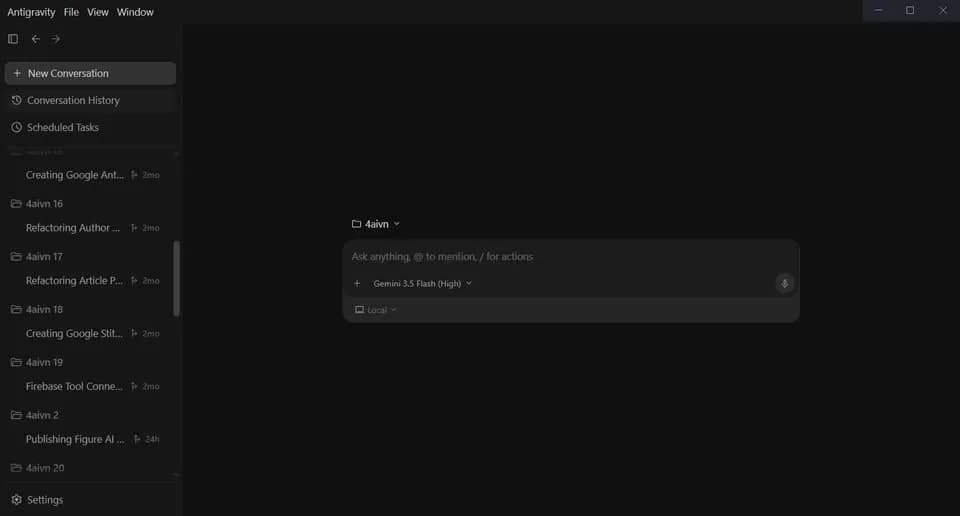
Despite boasting numerous powerful technological upgrades, Antigravity 2.0 is facing a wave of criticism from the user community due to radical interface changes. The new interface is now merely a minimalist console focused on a chat window for issuing commands to agents, completely eliminating the familiar IDE workspace. Many opinions suggest that this design looks exactly like a replica of the Codex or Claude Desktop application.

Antigravity 2.0's New Workspace Screen

This excessive minimalism has left many developers feeling disappointed and empty, as they no longer have the ability to quickly view and modify files directly as before. Having to switch back and forth between Antigravity and an external editor significantly reduces their actual work efficiency.

How to Restore the Traditional IDE Experience for Users

To appease the negative reactions from the community, Google has offered some temporary solutions for those not yet ready to adapt to the new interface. Users can visit the official Antigravity homepage to download a separate IDE version. This version will help restore the familiar integrated workspace with traditional source code editing features.

The Rapid Evolution of Tools like Antigravity and Codex

The separation between traditional code editors and agent control interfaces is clear evidence that AI is shifting from a supportive tool to an autonomous partner. Developers need to proactively familiarize themselves with new control tools like CLI and SDK to gradually transition their role from direct code writers to managers and orchestrators of intelligent agent ecosystems.

Discussion (0)

Log in to join the discussion.

No comments yet. Be the first!

Related Articles

How to combine Codex and Claude Code with one plugin

Is anyone else using Codex and Claude Code side by side? I only recently discovered the Codex plugin for Claude Code, published by OpenAI itself. The useful part is not simply having another AI available. It is being able to call Codex from the current Claude Code session for a code review, an adversarial design challenge, or a separate delegated task without constantly switching tabs and sessions. What makes the Codex plugin for Claude Code useful? The openai/codex-plugin-cc plugin is intended for developers who already work in Claude Code and want to add Codex to that workflow. Instead of allowing both agents to edit the same file at the same time, you can assign clear roles: Claude Code implements and Codex reviews, or Claude Code keeps the main thread while Codex investigates an independent problem in the background. The official plugin provides review commands such as /codex:review and /codex:adversarial-review, delegation through /codex:rescue, and job or session management through /codex:transfer, /codex:status, /codex:result, and /codex:cancel. Codex therefore becomes a collaborator inside the Claude Code workflow rather than a separate window. It does not create a separate Codex runtime The plugin uses the Codex CLI and Codex app server installed on the same machine. It also reuses the local authentication state, current repository checkout, and existing config.toml settings. Integration is straightforward, but each request still contributes to the user's Codex usage limits. Requirements before installation You need Node.js 18.18 or later and either a ChatGPT subscription, including Free, or an OpenAI API key. If Codex CLI is missing, /codex:setup can offer installation guidance. You can also install it manually with npm install -g @openai/codex and sign in with !codex login. How to install the Codex plugin in Claude Code Run these commands in Claude Code: /plugin marketplace add openai/codex-plugin-cc /plugin install codex@openai-codex /reload-plugins /codex:setup The last command checks whether Codex is installed and authenticated. Once setup is complete, the Codex slash commands should appear in Claude Code, along with the codex:codex-rescue agent under /agents. Try a background review first A low-risk first run is /codex:review --background. Use /codex:status to monitor it and /codex:result to retrieve the final review. Multi-file reviews can take time, so background mode keeps Claude Code available for other work. Three effective Codex and Claude Code workflows The value of the plugin comes from role design. If both agents modify the same area without boundaries, the result may be conflicting edits, repeated analysis, and wasted context. The following workflows make ownership clearer. Let Claude implement and Codex review After Claude Code completes a feature, run /codex:review for a read-only review. It can inspect current uncommitted changes or compare the branch against a base with /codex:review --base main. Because Codex does not edit files in this mode, the developer keeps control of what is accepted. For example, after Claude adds a payment flow across several modules, Codex can inspect logic errors, edge cases, and cross-file side effects. Claude Code can then evaluate the findings and apply only the changes that make sense. Delegate an entire task to Codex Use /codex:rescue for a problem that can be isolated, such as /codex:rescue --background investigate why the integration test is flaky. Claude Code can continue working on the interface or documentation while Codex investigates in the background. Rescue supports --background, --wait, --resume, and --fresh. Define the expected output and file scope before delegating. A vague instruction to fix everything while Claude Code is also editing the repository can still create collisions. A good task has a specific goal, completion criteria, and a clearly owned part of the codebase. Use adversarial review to challenge the project direction /codex:adversarial-review is designed to question implementation and design decisions rather than merely find bugs. For example, /codex:adversarial-review --base main challenge the caching and retry design asks Codex to inspect assumptions, trade-offs, alternatives, and risks such as data loss, race conditions, rollback, or reliability. This is where the two agents may appear to argue, but the debate only helps when a human sets a narrow question, requests evidence, and defines a decision rule. Otherwise, the review can become a chain of opinions with no practical outcome. Transfer sessions and manage background jobs /codex:transfer creates a persistent Codex thread from the current Claude Code session and prints a codex resume <session-id> command. It is useful when a discussion has grown beyond a short review and you want to continue directly in the Codex App or TUI without manually rewriting the context. Monitor, retrieve, and cancel work For background tasks, /codex:status shows progress, /codex:result returns the stored output and session ID, and /codex:cancel stops an active job. These commands prevent multi-agent work from becoming a black box. When a task drifts from its goal, canceling early is usually cheaper than waiting and starting over. Watch for review loops and usage limits Important: OpenAI explicitly warns that the optional review gate can create a long-running Claude/Codex loop and drain usage limits quickly. When enabled with /codex:setup --enable-review-gate, the plugin uses a Stop hook, which is an automated trigger that runs when Claude is about to finish its response, to start a targeted Codex review. If it finds an issue, Claude's response is blocked so Claude can address it first. This can be valuable before shipping, but it should not be left unattended. A practical safety checklist Assign roles before running: one agent implements while the other reviews, or each owns a separate task. Limit the scope by naming the branch, files, risk area, and completion criteria. Use background mode for large reviews and check progress periodically. Enable the review gate only while actively monitoring it, then disable it with /codex:setup --disable-review-gate. Do not let Claude review all Codex output and then ask Codex to review every Claude revision without a clear stopping rule. Use /codex:cancel when a task moves in the wrong direction. How can Codex and Claude Code work well together? The official OpenAI plugin offers a cleaner alternative to keeping Codex and Claude Code open in separate tabs or letting both agents edit the same file. Claude Code can remain the coordinator while Codex reviews, challenges a design, or owns a separate task. A sensible starting point is one small /codex:review --background run, followed by status, result, and cancel. Try rescue, transfer, and the review gate only after the basic workflow is familiar. The two systems can complement each other well, provided a person still sets the boundaries, budget, and stopping point.

Nam
14 Jul, 2026
How Hermes Agent creates reports and optimizes SEO

A useful report usually consumes time in three places: finding sources, organizing evidence, and checking whether conclusions are actually supported. Hermes Agent fits this work because web search, browser automation, files, memory, delegation, and skills can live inside one workflow. Once configured well, a manual process can become a reusable routine for weekly reporting, content audits, and keyword research.The practical method shared here is simple: research first, save evidence, draft last, and run SEO as a separate review stage. This is slower than asking an agent to write immediately, but the output is easier to verify and less likely to blur facts with assumptions.Why Hermes Agent fits reporting and SEOAccording to the official Hermes Agent documentation, the system includes more than 60 tools covering web search, browser automation, terminal, files, memory, cron, and delegation. Hermes also has a learning loop that can create skills from experience and improve them during use. That matters when a report or SEO checklist must run repeatedly.If you are new to the platform, start with our introduction to Hermes Agent and its self learning system. This guide focuses on execution: turning a business question into a sourced report and turning a URL into an actionable SEO review.The rule used in this workflow: Hermes may search, extract, organize, and recommend. A human still approves sources, conclusions, primary search intent, and every change that can affect a live website.Four tool groups to enableWeb and search: discover sources and extract evidence.Browser: inspect rendered pages and interact when extraction is insufficient.Files: save briefs, source tables, drafts, and final reports.Memory and skills: retain brand rules, report formats, and proven procedures.Use hermes tools to inspect and configure toolsets. For web research and file writing, enable only the relevant groups instead of granting broad terminal access. A smaller permission scope reduces accidental actions and produces cleaner logs.Set up Hermes Agent for the first runInstall and choose a modelFollow the official quickstart, then run hermes setup to select a provider, model, and tools. Hermes supports Nous Portal, OpenRouter, OpenAI, and custom endpoints, so the reporting workflow does not depend on one model provider.Use a model with sufficient context for source review, but do not spend flagship model pricing on every stage. Discovery, title normalization, and table formatting can use a cheaper model. Contradiction analysis and final synthesis deserve the stronger option.Create a clear workspaceGive each project its own folder with brief.md, sources.md, notes.md, report.md, and seo-audit.md. This structure tells Hermes which file defines the request, which stores evidence, and which is the final output. It also makes later comparisons easier.In a competitor report, I create one folder per month, list five sites in the brief, and require every conclusion to point to a row in sources.md. If a claim lacks evidence, Hermes must mark it as unverified instead of filling the gap.Use Hermes Agent to create a sourced reportStep 1: Write a brief with a completion testA useful brief answers five questions: who will read the report, which decision it supports, what time range matters, which sources are acceptable, and what sections the output must contain. A broad request such as researching the AI market encourages unnecessary scope.The prompt I use is: “Read brief.md. Find no more than 12 official or reputable sources published within the last 90 days. Save the URL, access date, main evidence, and the passage supporting that evidence in sources.md. Do not write the report until the source table is complete. Create a conflict section when sources disagree.”Step 2: Research before writingHermes provides web search and extraction, while browser automation is better for rendered pages and interactions. The Web Search and Extract documentation recommends browser navigation when summarization is not enough. Search broadly first, then open only important sources in the browser.The best output at this stage is not polished prose. It is a clean source table containing title, publisher, URL, date, evidence, and confidence. Missing dates and authors should remain missing rather than being guessed.Step 3: Synthesize around the business questionAfter sources.md is approved, ask Hermes to write report.md and separate facts, interpretation, and action. Readers can then see which statements are supported and which are analytical judgments.During one content report, Hermes found that traffic declined when several pages lost internal links. Instead of claiming a search penalty, the report preserved two hypotheses: weaker internal architecture and lower search demand. The first action was restoring links and observing the result, not rewriting the entire site.A useful verification prompt: ask Hermes to add a section called “What this report does not prove.” It is often the most valuable part of the document.Use Hermes Agent for practical SEOStart with search intentProvide the URL, audience, and conversion goal, then ask Hermes to identify the primary intent, supporting questions, related entities, and page type visible in search results. A keyword list alone often creates content that repeats phrases without satisfying the reader.A practical prompt is: “Inspect this URL with the browser. Identify one primary intent and three supporting intents. Compare the title, headings, introduction, topic coverage, internal links, and schema with five relevant results. Do not recommend keyword density. Every recommendation must name the location to change and the benefit for the reader.”Run an on page checklistHermes can review titles, descriptions, canonicals, hreflang, headings, alt text, internal links, structured data, and duplicate content. Browser automation is useful because it sees the rendered page. Keep audit permissions separate from editing permissions so a review cannot silently modify production.Does the title describe the intent without duplication?Does the introduction answer the main question early?Do H2 and H3 headings create a clear reading path?Do internal links lead to deeper, relevant explanations?Does schema match content visible to users?Are image URLs valid and alt descriptions useful?Create a content brief before draftingDo not ask Hermes to write the SEO article immediately after research. Require a content brief with persona, intent, angle, H2 and H3 structure, evidence, internal links, and unresolved questions. Approve the brief before drafting.For this Hermes Agent guide, the brief includes more than the phrase “Hermes Agent SEO.” It requires an explanation of toolsets, real prompts, browser permission warnings, a link to the foundational article, and a checklist for measuring the result.Turn the workflow into a reusable skillHermes is distinguished by its skill system. The quickstart describes skills as instruction documents loaded when a task matches, while the learning loop can suggest preserving procedures after complex work. Once a reporting workflow succeeds two or three times, convert it into a skill instead of maintaining a long prompt.What a reporting skill should containTrigger conditions and accepted inputs.Required folder and file names.Source selection rules and conflict handling.Report format, source table, and unverified section.A review checklist before delivery or publication.For an SEO skill, add rules that prevent production edits, forbid unsupported schema, and protect canonical URLs. These safeguards are more important than a keyword list because they stop plausible but harmful changes.Schedule reports with cronHermes supports scheduled automation and delivery to messaging platforms. A weekly report can run on Monday morning, collect new evidence, compare it with the previous week, and send a summary. Automate reading and synthesis, but keep publication and SEO changes behind approval.Protect sensitive data: sanitize customer information, limit file and browser access, and use command approval or isolation when Hermes can access a terminal.Mistakes I encounteredThe objective is too broad“Analyze the entire website” produces a long output with little direction. “Find three evidence backed causes for an impressions decline in tool articles” produces a smaller report that supports action. Scope should connect to a decision.Writing begins before source reviewPolished prose can hide weak sources. Separating sources.md from report.md makes errors visible. Review the evidence table before synthesis.SEO is reduced to one scoreA single score does not explain what to change. Hermes should return an issue, evidence, priority, effort, and a validation method. Recommendations that cannot be measured should rank lower.The workflow never becomes a skillIf the same prompt needs correction every week, the learning loop is being wasted. Record mistakes, update the checklist, and improve the skill after every run.How should you start?Choose one small report, no more than five sources, and one clear decision. Create a brief, ask Hermes for a source table, approve the evidence, and only then permit report writing. Use the same evidence for a content brief or SEO audit, but do not let the agent publish automatically.Once the process is stable, save it as a skill and add a final review checklist. Hermes Agent is most valuable not because it writes one report faster, but because it turns a good method into a procedure that can be repeated, inspected, and improved over time.
Nam
11 Jul, 2026
GPT-5.6 vs Claude Fable 5: What Is New?

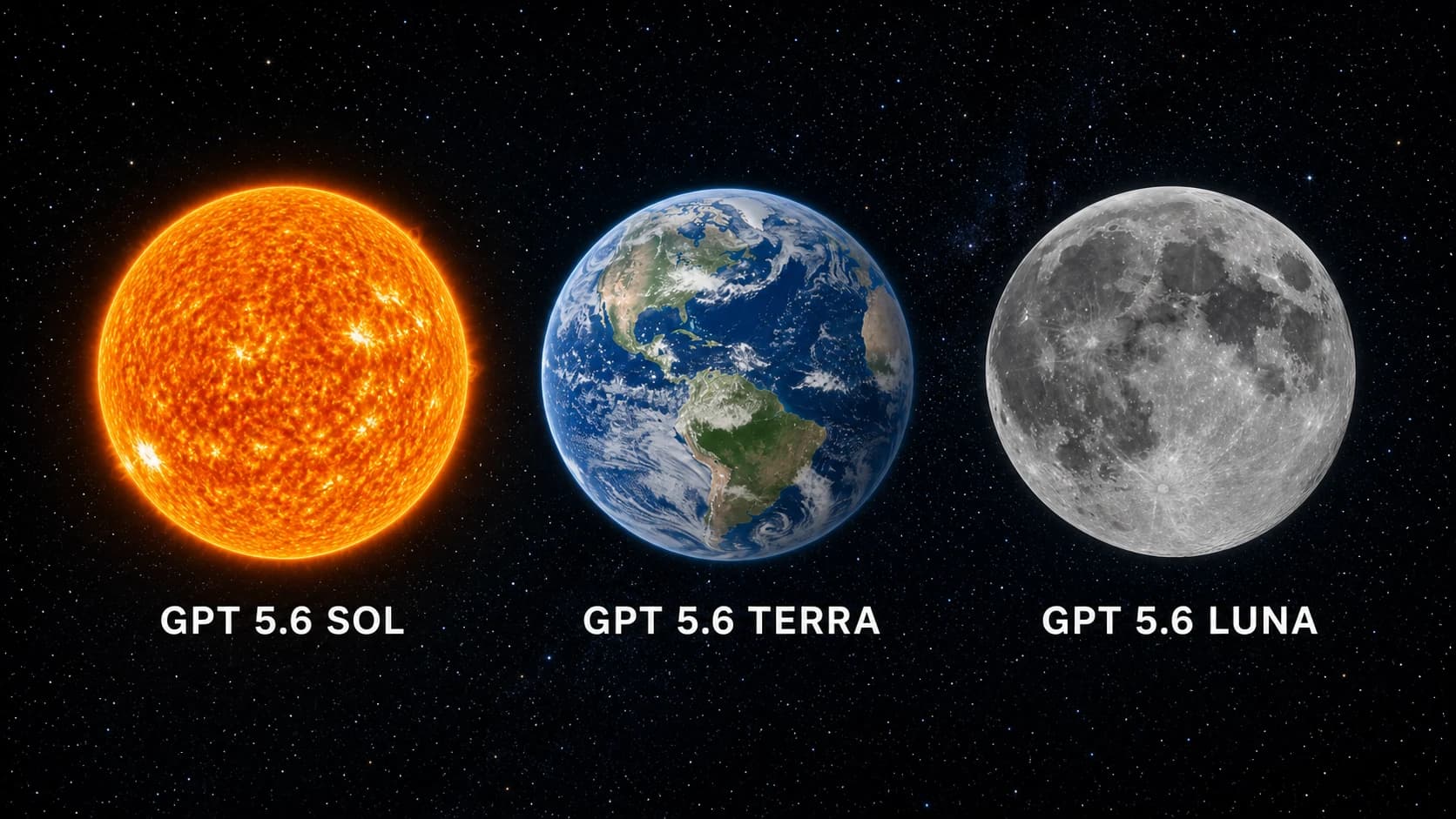
Sol, Terra, and Luna make GPT-5.6 look more like a product family than a single model. The naming also signals what OpenAI is trying to change: users no longer have to choose only between an expensive flagship and a much smaller model. Instead, they get three capability tiers designed for different workloads. The important caveat is that GPT-5.6 is currently in limited preview, and OpenAI says it is not available in ChatGPT during this preview period.On the other side, Anthropic positions Claude Fable 5 as a frontier model for reasoning, software engineering, scientific research, and long horizon agentic work. The useful question is therefore not simply which model is smarter. It is which product architecture helps a team complete real work with predictable quality, latency, and cost.What GPT-5.6 actually isAccording to OpenAI's preview announcement, GPT-5.6 consists of Sol, Terra, and Luna. Sol is the flagship and most capable option, Terra is a strong lower cost model, and Luna is the fastest and most cost efficient member of the family.The important change is how OpenAI divides demand into three tiers. A research team might use Sol for a difficult reasoning problem, a product team might run most daily work on Terra, and a high volume system might use Luna for thousands of short requests. This looks more like an infrastructure strategy than the launch of a single new chatbot.Availability matters: OpenAI says GPT-5.6 is not available in ChatGPT during the preview. An experience in an API, developer tool, or partner platform should not be treated as the final ChatGPT experience.Sol is designed for difficult, extended workSol is positioned as the strongest GPT-5.6 model for deep reasoning, complex coding, and long multi step tasks. A software team might ask it to understand a repository, identify the cause of a bug, propose a minimal patch, and write regression tests. Sol's value is not answering a short question quickly. It is maintaining the objective while working through a longer chain of decisions.OpenAI also highlights stronger cyber capability as reasoning increases. That can be useful for authorized security testing and vulnerability analysis, but it also makes access controls, logging, sandboxing, and human approval more important.Terra aims for the practical middleTerra targets the broadest category of work: document analysis, content production, application development, research synthesis, and operational support. If Sol is the specialist called for the hardest problem, Terra is the strong team member expected to work throughout the day without making every request unnecessarily expensive.A marketing team could use Terra to read market reports, extract insights, build an outline, and draft several content variants. A development team could use it for code review, test generation, and tickets with a clear scope. This tier could become the default if its real world quality remains consistent.Luna prioritizes speed and scaleLuna is designed for low latency and lower cost. Classification, conversation summaries, field extraction, drafting, and ticket routing do not always require the strongest model. In these cases, response time and total operating cost matter more than maximum reasoning capability.Fast does not mean suitable for everything. If a task requires source verification, a long plan, or a code change with a large blast radius, a team should move it to Terra or Sol instead of forcing Luna beyond its intended role.Claude Fable 5 takes a different routeAnthropic presents Claude Fable 5 as a frontier model for reasoning, software engineering, vision, scientific research, and long horizon agentic work. Instead of emphasizing three product tiers in one generation, Anthropic's message focuses on the capability of a powerful model working inside the Claude ecosystem.This difference changes deployment decisions. With GPT-5.6, an engineering team might build a router that sends each request to Sol, Terra, or Luna. With Fable 5, the focus may be on optimizing prompts, tools, context, and reasoning budgets around one primary model. Neither approach is universally better because the answer depends on workload and operational maturity.A fair comparison: Do not run one prompt and declare a winner. Build a test set covering short tasks, long reasoning, coding, extraction, and recovery from errors. Measure accuracy, latency, the number of human corrections, and the total cost of a completed task.Coding and agentic work depend on the surrounding toolsBoth GPT-5.6 Sol and Claude Fable 5 target complex software work, but the practical experience depends heavily on the system around the model. The ability to read a repository, execute commands, observe results, and correct mistakes can matter as much as a benchmark score. For OpenAI workflows, the Codex page is a useful starting point for understanding how a model participates in coding work.Fable 5 may be attractive to teams already invested in Claude and long running agentic workflows. Read our Claude Fable 5 coverage for more context on Anthropic's positioning and the types of work it targets.What early forum experience tells usEarly discussions on Reddit and developer communities focus on how different Sol, Terra, and Luna feel in real work. Some users describe Sol as the better fit for multi step tasks, Terra as the practical option for routine work, and Luna as the interesting choice for speed. These observations match OpenAI's positioning, but they do not establish a precise quality gap.Forum reports are useful because they reveal the questions real users care about. However, they are self selected evidence. People may use different prompts, access levels, integrations, and preview versions. A result from a developer platform does not guarantee the same result when a model eventually appears in ChatGPT.Early positivesThe three tiers make it easier to understand which model belongs to which workload.Luna creates a clear expectation of low latency for high volume systems.Terra could become a default if it delivers stable quality at a practical cost.Sol is expected to be stronger for coding, long reasoning, and tasks with several verification steps.Open questionsHow large the practical quality gap between Sol and Terra will be on common workloads.The total cost after retries, corrections, and human review are included.How Luna behaves with long prompts and many constraints.Whether performance remains stable as GPT-5.6 expands beyond preview access.Forum reports are not benchmarks: Community experience should help you choose test cases, not make a production purchasing decision by itself.Comparing GPT-5.6 and Fable 5 by workloadWriting and document analysisTerra appears positioned for most document work because it balances capability and cost. Fable 5 may be attractive when documents are long, questions are complex, and the model must maintain an argument across a large context. A useful evaluation should score citation accuracy, structural consistency, and how much editing is required before publication.Software development and debuggingSol and Fable 5 are both candidates for difficult coding tasks. A representative test should include reading existing code, identifying the root cause, producing a minimal fix, writing tests, and explaining risk. Asking a model to create an isolated function from scratch does not reflect how well it works in a real repository.High volume processingLuna has the clearest positioning advantage when speed and cost dominate. At thousands of extraction or classification requests per day, a small difference in price and latency can have a large effect. Fable 5 may be unnecessarily expensive for a workload that only needs short, structured outputs.Research and long reasoningSol and Fable 5 should be compared with tasks that have verifiable outcomes rather than open questions that merely sound impressive. Give both models the same research material and ask them to identify assumptions, detect contradictions, propose an experiment, and explain what evidence is missing. The better model is the one that helps users discover errors faster, not the one that writes the longest answer.Should you choose Sol, Terra, Luna, or Fable 5?If you want maximum capability inside the OpenAI ecosystem, Sol is the first model to test. If you need a strong model for regular use, Terra has the more practical position. If your workload contains many short and repetitive tasks, Luna could reduce operating cost. Fable 5 remains relevant for teams invested in Claude or focused on long reasoning and agentic work.Because GPT-5.6 is still in preview, replacing an entire production workload would be premature. Run the models in parallel on real but sanitized data, record failures, and use the same criteria for every candidate.A test plan you can use nowSelect 20 tasks that represent real work, including easy and difficult cases.Run each task on Sol, Terra, Luna, and Fable 5 when access allows.Score accuracy, response time, total cost, and required human correction.Track severe failures separately instead of relying only on averages.Choose a model for each workload category rather than forcing one model to do everything.Is GPT-5.6 worth switching to now?The most important change in GPT-5.6 may not be Sol's raw capability. It is OpenAI's decision to turn one model generation into three operational tiers. That could help organizations control cost, but only if they can classify workloads and route requests intelligently.The practical next step is to build a small benchmark from your own data. If Sol wins difficult tasks, Terra is good enough for routine work, and Luna handles high volume requests reliably, the three tier architecture has real value. If Fable 5 remains more consistent on long reasoning, a multi model strategy may still be better than committing to one provider.

Liên
9 Jul, 2026
YC CEO's 6 forcing questions before starting any project

I'd heard a lot about the gstack repo from the CEO of Y Combinator, so I got curious and installed it to try. What surprised me most wasn't the polished workflows — it was the genuinely different mindset behind them. That mindset shows up in the very first command: /office-hours, with six questions that don't ask about code at all, only the things most people haven't thought through before they start building. What is gstack and why did Garry Tan build it gstack is an open-source toolkit by Garry Tan, CEO of Y Combinator, built primarily for Claude Code. The core idea: instead of using AI as a plain code writer, Garry Tan wanted to turn Claude into a small AI agent team, where each member handles a different role — from product direction and security review to testing and release. The entire workflow runs in an ordered loop: Think → Plan → Build → Review → Test → Ship → Reflect. More specifically, gstack splits Claude Code into 23 specialized roles, and the output of each step is automatically passed to the next — no manual handoff needed. Some of the standout commands: /office-hours 6 questions that force you to rethink your feature before writing a single line of code /plan-ceo-review checks whether you're overbuilding or underbuilding relative to what's actually needed /review catches serious bugs that standard automated checks miss /qa opens a real browser, performs real interactions, finds real bugs /cso runs an automated security audit against international standards /ship syncs, tests, pushes code and opens a pull request in a single command How effective is gstack? Garry Tan says his working speed in 2026 is roughly 810 times faster than in 2013, measured by lines of completed code per day (11,417 vs 14). In 60 days, he shipped 3 production services and over 40 features — all while running Y Combinator full-time. Andrej Karpathy, co-founder of OpenAI, confirmed a similar trend, sharing that he hasn't typed a single line of code himself since December 2025 thanks to AI agents. But among all those commands, /office-hours stands out for the opposite reason from the rest, it doesn't help you work faster and it helps you avoid building the wrong thing from the start. Why Garry Tan puts /office-hours first Garry Tan placed /office-hours at the top of the workflow based on a simple observation: most products fail not because of poor code, but because they build the wrong thing. Teams spend weeks on a feature nobody needs, or build the right feature for the wrong audience, or solve a problem users already handle better another way. The command has two modes: Startup mode for founders and people building real products with real users, and Builder mode for side projects, hackathons, and open source. This article focuses on Startup mode, where the 6 questions are most directly applicable. 6 questions that stop you from building the wrong thing These aren't 6 questions to answer quickly and move on. They're designed to make you think honestly, because the more truthful your answers, the more accurately Claude can match what you actually need — saving you a significant amount of time later. You can read the full original prompts at office-hours/SKILL.md.tmpl. Demand reality: Is there a real need? Original question: "Who specifically has this problem? How are they solving it today?" Not "users in general" or "the marketing team" — the goal is to name one real person, ideally by name, who is actively struggling with a specific problem. If you can't name someone like that, you don't yet understand what they actually need. Concrete example: Instead of "users want better task management," it should be: "Minh, a project manager at a 20-person company, copy-pastes between Notion and Google Sheets every Monday morning because the two tools don't sync." Apply this to your own situation accordingly. Status quo: What are they using instead? Original question: "What is their current workaround? How much better do you need to be for them to switch?" Everyone is already solving their problem somehow — whether with Excel, sticky notes, or a WhatsApp group. If their current solution is good enough, they have no reason to migrate their data and learn an entirely new platform. Your solution needs to be meaningfully better before they'll even consider switching. Desperate specificity: Who needs this badly enough? Original question: "Who needs a solution badly enough to use your ugly beta version today?" This is the question that separates nice-to-have from must-have. If you can't find anyone willing to use an incomplete, rough, buggy version right now, the problem you're solving isn't urgent enough. Real early users are people who need a solution badly enough to tolerate an unpolished product — as long as it's moving in the right direction. Narrowest wedge: What is the smallest possible piece? Original question: "What is the smallest thing you could launch tomorrow? Not the full vision — the smallest piece." Not the first full-featured version — something even smaller than that. This question typically cuts 80% of the scope people add because they think "might as well do it while I'm here." It's a trap many builders fall into, including myself. Launch the smallest meaningful piece first, listen to real users, then decide whether to expand. Common mistake: Many people confuse "smallest piece" with "first full-featured version." The narrowest wedge truly means one small thing that solves one specific problem for one specific group of users — nothing more. Observation and surprise: Have you watched real people use it? Original question: "Have you watched real people use your product? Did they use it in ways you didn't expect?" This question is best saved for the second iteration onward, once you have something to test. Rather than asking for feedback through messages or surveys, sit and watch directly — or review screen recordings. The most valuable insights usually don't come from what users say, but from what they do that you didn't design for, or what they skip that you thought was important. Note: If you're in your first iteration and don't have a product yet, you can skip this question and come back after launching the smallest piece in step 4. Future-fit: The 2 to 3 year view Original question: "In 2-3 years, will what you're building still be relevant — or is the trend moving against you?" This isn't about predicting the future precisely. It's about avoiding building something that's already fading. If the trend is making your problem less urgent over the next two years, that's a clear signal to reconsider from the start. That said, if your goal is to move fast and capture the market before big tech ships something similar, this question can reasonably be set aside. A real example: a simple idea completely flipped In the gstack documentation, Garry Tan walks through a practical example. You open /office-hours and say: "I want to build an app that summarizes my daily work calendar." Claude doesn't agree and start executing. Instead, it pushes back: what you just described isn't a calendar summary app — it's actually a full personal AI chief of staff. These are entirely different in scope, technical complexity, and user expectations. From that single opening description, /office-hours helps you see: 5 features you were describing without realizing it 4 assumptions that need to be validated before building 3 different implementation directions with varying levels of complexity 1 recommendation: launch the smallest piece first, treat the rest as a long-term roadmap All of this happens before you write a single line of code. The output is saved as a document that subsequent steps in the workflow automatically pick up and continue from. These 6 questions work even without gstack The 6 questions from /office-hours don't require Claude Code or a gstack installation. They're a way of thinking — the same framework YC partners use to evaluate startups — and you can apply them right now with any AI tool you already have. The difference when using them through gstack is that Claude won't let you give vague answers. It pushes for specifics and won't move forward until your response is grounded enough to be useful. That's why /office-hours tends to be the most uncomfortable command in the entire toolkit — not because it's difficult to use, but because it asks exactly what you've been avoiding. Try it today: Before starting your next project, paste these 6 questions into Claude, Gemini, or ChatGPT along with your idea. Ask it to go through each question one at a time and not let you skip any. The results are often more surprising than you'd expect — even for ideas you've already thought through carefully. gstack currently has over 117k stars on GitHub and is still growing. For me, the most valuable part isn't the technical commands like /review or /ship — it's /office-hours, because it's the only command in the entire toolkit that forces you to stop and think before doing anything else.

Nam
27 Jun, 2026