4AIVN
Back to News

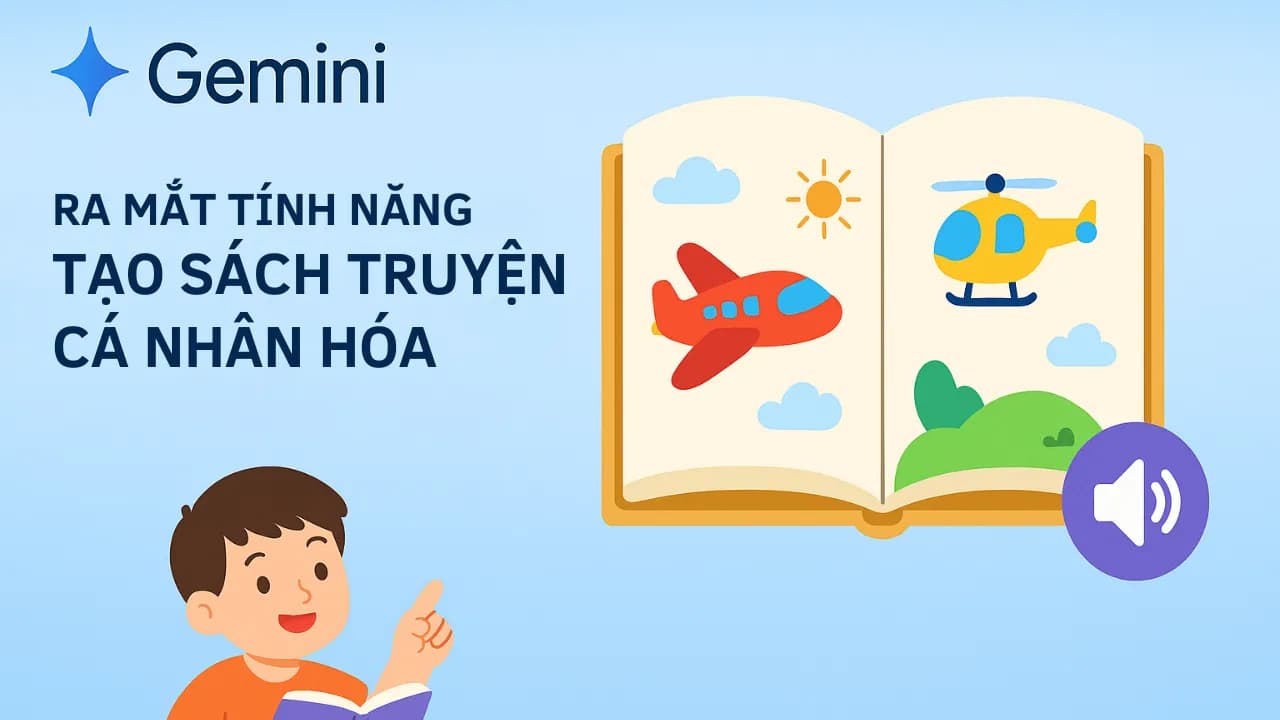
Gemini Launches a Personalized AI Storybook Creation Feature
Published on 9 August, 2025
Gemini Launches a Personalized AI Storybook Creation Feature

Quick Summary

Gemini has launched a feature that lets users create personalized illustrated storybooks with narration directly in Canvas. From a simple description, Gemini can generate a 10-page book with custom images and high- or low-pitched narration inspired by the user's own photos or drawings. The feature supports more than 45 languages, offers multiple illustration styles, and works with Gemini 2.5 Pro and Flash on both mobile and desktop. It can help children learn, bring artwork to life, or turn personal memories into unique stories.

An incredibly exciting update has appeared in the Gemini app, opening up a completely new way to turn your ideas into reality, from here, personalized illustrated storybooks complete with voice narration support.

Google introduced this new feature on August 6, 2025, very close to the launch date of GPT-5. Therefore, the level of interest, of course, cannot be compared to the event from OpenAI. However, this is still an extremely useful and interesting feature, allowing you to easily create unique stories that suit every imagination.

How Does the Feature Work?

Simply describe any story you can imagine, and Gemini will create a unique 10-page book with custom illustrations and narration. To enhance personalization, you can ask Gemini to draw inspiration from your own photos or hand-drawn sketches, or those of your children.

A notable advantage is that the entire story and narration creation process is done directly on Gemini's Canvas, allowing for quick and easy operation without needing to switch to another application.

Currently, Gemini offers two basic narration options: a high-pitched voice (typically female) and a low-pitched voice (typically male). Users cannot yet use their own voice for increased personalization, but Google will certainly update this feature soon.

A Wide Range of Styles and Languages

You can bring your ideas to life in various styles: from pixel art, comics, claymation, crochet, to coloring books. Furthermore, this feature supports over 45 languages – including Vietnamese – helping to expand creative possibilities without limits.

Powered by Gemini 2.5 Flash and Gemini 2.5 Pro

Users can experience this feature for free on both Gemini 2.5 Pro and Gemini 2.5 Flash, or it will later appear on Gemini 3. However, books created by Pro generally yield smoother and more detailed results, while Flash is still sufficient for basic experiences.

Because it operates directly on Canvas, you can use the storytelling feature anywhere – from desktop computers to mobile devices.

Ways to Use the Storybook Feature

  • 📖 Help your child understand a complex topic: for example, create a story explaining the solar system for a 5-year-old.
  • 💡 Teach a lesson through storytelling: teach a 7-year-old boy about kindness to his sibling by making an elephant the main character.
  • 🎨 Bring artwork to life: upload your child's drawing and let Gemini bring it to life through an illustrated storybook.
  • 🌍 Turn memories into magical stories: upload photos from your family's Phu Quoc trip to create a unique adventure.

👉 Try it now to turn your stories and ideas into unique and captivating illustrated books!

A Real-World Prompt Example

Below is a prompt that we tested, and you can refer to the results:

Prompt “Draw a comic book for a 3-year-old about transportation vehicles such as airplanes, helicopters, cars, motorcycles, cranes, excavators, etc.”

Gemini storybook illustration result

Gemini storybook cover

Gemini storybook illustration result

Gemini storybook illustration result

Gemini storybook page

Gemini storybook illustration result

Gemini storybook illustration result
Gemini storybook page 2

Gemini storybook illustration result

Discussion (0)

Log in to join the discussion.

No comments yet. Be the first!

Related Articles

Gemini 3.6 Flash Launches but Disappoints in Practice

Google announced Gemini 3.6 Flash on July 21, 2026, with sharp benchmark gains over 3.5 Flash: DeepSWE rose from 37% to 49%, MLE Bench from 49.7% to 63.9%, and OSWorld Verified reached 83%. Yet 4AIVN's hands-on experience tells a very different story. The model handles small jobs reasonably well, but a multi-step plan can make it forget the objective, skip steps, and drift halfway through the work. Stronger benchmarks do not reflect real-world use According to Google's official announcement, Gemini 3.6 Flash uses 17% fewer output tokens than 3.5 Flash on the Artificial Analysis Index, while tests such as DeepSWE show token reductions of up to 65%. Its input window reaches 1,048,576 tokens and its output limit is 65,536 tokens, impressive numbers on paper. The problem is that these figures come from designed tests with a fixed objective and a relatively contained run. That is not how a real plan operates. Production work changes continuously in response to feedback rather than ending after one self-contained attempt. Following a long plan is the critical weakness In hands-on use, Gemini 3.6 Flash performs poorly as soon as it moves beyond a single task. Give it a small job with explicit checks and it can work well with few unnecessary loops. Give it a multi-step plan and it may forget the original objective, skip previously agreed steps, or drift after several turns. When corrected, it sometimes apologizes and then repeats the same mistake instead of actually fixing it. A one million token window describes input capacity, not memory quality. The model may be able to “see” the full context and still miss details during execution; one overlooked constraint can push the entire plan off course. This is not a rare random failure but a repeated weakness that is difficult to ignore. Gemini 3.6 Flash is strong at completing one job quickly, but it is not yet dependable at completing a sequence of jobs correctly. That is the gap the benchmarks do not measure. A 17% price cut may not match the quality Gemini 3.6 Flash is priced at $1.50 per million input tokens and $7.50 per million output tokens, about 17% below the $9 output price of 3.5 Flash. On the surface, this is a sensible improvement: lower cost and higher benchmark scores. But if long tasks are executed poorly, the savings can quickly disappear through repeated reminders, corrections, and complete reruns of the plan. Gemini 3.5 Flash Lite is cheaper still at $0.30 per million input tokens and $2.50 per million output tokens, but it targets simple classification and data transformation workloads that do not require the model to preserve a long plan. What do you gain and lose with Gemini 3.6 Flash? Objectively, this is not a failed upgrade. Google has likely made careful tradeoffs among output quality, speed, and cost, even if real-world behavior does not fully meet the high expectations attached to its engineering team. The improvements are real rather than purely theoretical: responses are faster, output costs are lower, and the model is efficient on short, narrow tasks such as content classification, writing one code function, or answering a specific question. In those cases, it keeps unnecessary loops to a minimum. The cost becomes visible when work extends beyond a few steps. The more constraints and earlier decisions the model must preserve, the more likely it is to drift. For coding agents or long workflows already running reliably on Claude Fable 5 or GPT 5.6, there is not yet a convincing reason to switch to Gemini 3.6 Flash solely because of benchmarks or lower pricing. Gemini 3.5 Pro is still the model to wait for Google says Gemini 3.5 Pro is still being tested with partners and will be released broadly when it is ready. The central story of this launch is therefore the sizeable gap between benchmarks and real work. Anyone looking for a dependable agent for long-running workflows may still need to wait and see whether 3.5 Pro delivers a genuine step forward. If future releases remain underwhelming in practice, Google risks surrendering its advantage to competitors including Anthropic, OpenAI, and Meta.

Nam
23 Jul, 2026
Gemini powers Argentina and Messi at World Cup 2026

Gemini has won big in the most literal sense, right as Messi scored his first hat-trick at the 2026 World Cup, leading Argentina to a crushing 3-0 victory over Algeria and equaling Miroslav Klose's record of 16 World Cup goals. That historic moment became the perfect launchpad for Gemini. Back in March 2026, Google and the Argentine Football Association (AFA) made a bold decision: rather than simply printing a logo on training kits, they signed a deal for the AI to actively support tactical preparation and professional decision-making. That bet has now proven to be the right call. From training kit to the tactical meeting room The agreement between AFA and Google was unveiled at Times Square, New York, a venue deliberately chosen to capture global media attention. The Gemini logo appears across all training apparel for Argentina's men's, women's and youth squads, sitting alongside Adidas and American Express in AFA's top sponsorship tier. But the interesting part isn't the jersey. According to Inside World Football, Argentina's coaching staff will use Gemini for three specific purposes: tactical analysis, injury prevention and decision support. In other words, Gemini now has a seat in meetings that previously belonged only to Scaloni and his assistants. Google has not publicly disclosed which specific Gemini tools have been integrated into AFA's workflow. What is clear is that they are using the World Cup to bring Gemini into the reality of professional football, and the results will be graded in public. What is Gemini actually doing in the dressing room? Argentina arrives at the 2026 World Cup as the reigning champion. Every decision Scaloni makes, from the squad list to the starting eleven, is scrutinized more closely than any other team, and that is precisely why Argentina has become the most ideal testing ground Google has ever had for Gemini in professional football, especially at a major tournament. Tactical analysis Gemini is used to process match data for both Argentina and their opponents, covering movement statistics, attacking patterns and defensive vulnerabilities. Instead of the coaching staff spending hours reviewing footage, AI synthesizes the data and generates tactical diagrams automatically, saving significant preparation time before each match. Injury prevention This is a problem every major team wants to solve, especially when Messi and several key players are at an age that requires careful management of training loads. Gemini analyzes biometric data and injury history to issue early warnings, helping the coaching staff adjust intensity before problems actually occur. That is part of the reason why, immediately after completing his hat-trick, Scaloni chose to substitute Messi off, prioritizing fitness and safety for the matches ahead. AI in injury prevention is nothing new. Premier League clubs have had Microsoft as a partner for similar purposes. What is different this time is that Gemini is integrated directly into the workflow of a national team competing at a major tournament, not just at club level. For fans: create Messi content, follow scores without unlocking your screen Alongside supporting the coaching staff, Gemini has also rolled out a range of features aimed at fans, and this is the side that hundreds of millions of people will actually experience. Gemini lets you create content about players directly Users can generate images, songs and digital content featuring Argentina players like Messi directly inside the Gemini app. The feature is designed to bring the World Cup experience closer to those who cannot attend matches in person. Real-time scores and automated daily briefings On Google Search, live match scores can be pinned to the lock screen and update in real time, with dedicated animations for goals and red cards, all without needing to unlock the phone. For paid Gemini users, the Scheduled Actions feature allows an automated daily football briefing to be set up, covering scores, news and fixtures, delivered at a chosen time without needing to prompt it each day. Match-day infrastructure Google has updated Street View at all 16 host stadiums and optimized routing on Waze for match days. Waze also surfaces live scores when the car is stopped at red lights, so drivers do not need to pick up their phones while on the move. The 2026 World Cup is the real test for AI in sport Google is not sponsoring Argentina alone. Gemini also appears on the kits of France, Morocco, Iraq, Turkey and the United States, while Pixel is the official phone of the French squad, which is also using Gemini for internal communications. This is clearly a comprehensive strategy from Google, not a one-off deal. What makes the 2026 World Cup particularly significant is that it will answer a question no lab environment can: what do users actually do with AI when a World Cup runs for six weeks across 104 matches? Features that run on initial novelty will fade after the group stage. Whatever users keep coming back to all the way through the final is the honest answer to where AI actually fits in everyday life, and Google knows it. Google's communications director for Latin America, Flor Sabatini, stated that the 2026 World Cup will mark a before and after in the history of football because of AI. It sounds like marketing, but the reality is that this is the first time a major AI model has been integrated into the preparation of the reigning world champions, right in the middle of the most-watched sporting event on the planet. The 2026 World Cup is Gemini's real test The most significant part of this entire story is not the Gemini logo on Messi's jersey. It is the fact that Argentina, still the most expected to win and the most scrutinized team, carrying the pressure of defending the title, has committed part of its preparation process to AI. If Argentina succeeds, Gemini will have a case study that no advertising budget can buy. If Argentina falls short and the coaching staff attributes any part of it to AI, the narrative will flip entirely. Either way, this is the first time AI has been held accountable on a stage that genuinely matters, not a benchmark, not a demo, but the World Cup. For AI users, what is worth watching is not just whether Argentina wins, but whether Gemini actually changes how a football team operates, or whether it turns out to be nothing more than a logo on a training kit that looks better than previous years.

Nam
17 Jun, 2026
Supercharge your workflow by connecting Gemini and NotebookLM

You have been using NotebookLM to store documents, research, and notes — but every time you needed AI to process something further, you had to open Gemini, copy-paste manually, and hope the AI didn't fabricate inaccurate figures. Now, after discovering this integration, that extra step can be eliminated entirely: NotebookLM can connect directly into Gemini, turning all your documents into an immediate knowledge base for AI to work from. NotebookLM and Gemini used to be two separate islands NotebookLM is very good at one thing: staying anchored to the documents you provide and answering accurately based on them. You can upload a 200-page financial report and ask about any figure, and NotebookLM will cite the exact page and passage. However it is isolated within individual notebooks and cannot search for new information outside those documents. Gemini is the opposite: flexible thinking, real-time web access, and genuine creativity — but highly prone to hallucination when working with specialized data without a clear source. The result is that anyone who knows both tools has to use them in parallel, transferring data back and forth manually, which wastes time and introduces errors. This integration solves exactly that problem by bringing NotebookLM directly into the Gemini interface, letting the two tools complement each other rather than operating independently. A few things to know before connecting Gemini and NotebookLM Because they share the Google ecosystem, the Gemini and NotebookLM integration works smoothly — but there are a few things worth knowing to avoid setting the wrong expectations. Gemini prioritizes data from your notebook first, but when the notebook doesn't contain enough information, it will automatically search the web without you needing to issue an additional command. This is convenient, but it also means you should check the citations to know whether an answer came from your documents or from a web search. Cross-notebook analysis across multiple notebooks simultaneously is a major capability that standalone NotebookLM couldn't offer. The more notebooks you connect, the more Gemini can surface different perspectives and contradictions while still staying grounded in the full context. Every answer drawn from notebook data also includes specific source citations, which is an important difference from standard Gemini and lets you verify information quickly when needed. How to connect NotebookLM to Gemini in 4 steps The feature is now available for both free accounts and Google AI Pro with no additional setup required. Follow this sequence. First, open Gemini on the web or mobile app and go to the chat input as normal. Next, click the "+" icon in the corner of the chat window and select NotebookLM from the list of sources. Then choose one or more notebooks you have already created to serve as context for the conversation. Finally, type your prompt as usual, keeping in mind that Gemini will prioritize data from the notebook first and only search the web when the notebook doesn't contain enough information. The entire setup takes under 60 seconds, and you can switch between different notebooks within the same conversation. What can Notebook and Gemini together do that neither could before? The biggest change isn't speed — it's the reliability of the output. When Gemini has specific source data from a notebook, every answer comes with clear citations so you know exactly which page and document the information came from, rather than having to verify it yourself. In practical terms, there are four scenarios where this combination makes the most noticeable difference. Research and document synthesis Instead of reading through a 500-page textbook, you upload it to NotebookLM and ask Gemini to condense it into a study book, an infographic, or a presentation deck through Canvas mode. Here is what that looked like with a standard prompt turning selected notebooks into a book. You can see the result at this Gemini link. Writing content without worrying about hallucination This is the most useful use case for content creators. NotebookLM handles the "accurate" side by keeping figures, names, and events anchored to the source documents. Gemini handles the "compelling" side by writing prose, crafting hooks, and finding interesting angles. The output still doesn't quite match Claude in quality, but it makes an excellent reference to hand off to Claude for a final rewrite, and the result from that combination is genuinely strong. Gems that update their own knowledge Gems are custom AI assistants inside Gemini. When you attach a notebook to a Gem, the notebook syncs automatically: whenever you add new documents to NotebookLM, the Gem updates immediately without needing to be reconfigured. For example, if you have a Gem dedicated to customer support, every time company policy changes you simply update the notebook and the Gem understands the new information right away. Audio overviews combined with web search NotebookLM already has a feature for converting documents into conversational podcast-style audio, which is genuinely useful. When combined with Gemini, you can ask AI to supplement that audio summary with the latest information from the web, making it practical to listen while commuting and still stay current with the newest developments. Where to start if you haven't used NotebookLM and Gemini together before If you haven't used NotebookLM yet, start by uploading a document you frequently need to reference — an internal company process, a course syllabus, or an industry report you follow. Create a notebook from that document, then open Gemini and connect the notebook. Try asking a few questions that previously would have required reading the entire document to answer. When the AI answers accurately and cites sources clearly, you will immediately understand why this combination is worth using regularly. Not because it is "revolutionary" or "groundbreaking," but because it solves one specific tedious problem that you have been handling manually every day.

An
27 Mar, 2026
Create a free mini app with just a few clicks using Google AI Studio

Artificial intelligence (AI) is fundamentally changing how people build applications. You no longer need to be a professional developer. With a smart AI assistant, you can turn any idea into a real product. Google AI Studio is the clearest proof of that shift. The platform lets anyone, even without coding knowledge, build their own app. With the latest update, creating an AI app is as simple as having a natural conversation: describe your idea in plain language, and let AI handle the rest. Google AI Studio: Build AI apps without code and create Android apps with ease Google AI Studio is a browser-based development environment designed to simplify prototyping and building applications on top of Google's powerful AI models. Notably, the platform now supports direct creation of complete Android applications, opening the door for anyone who wants to ship a mobile product without writing a single line of code. If Gemini was once described as the "brain" of an application, Google AI Studio now gives it "hands and feet" through direct connections to APIs and SDKs within Google's ecosystem (via the "Supercharge your apps with AI" section). This makes expanding functionality incredibly easy, and you can make your app behave exactly as intended without manually configuring APIs or SDKs from scratch. Third-party APIs and SDKs still require manual input, but Google's vast ecosystem including Nano Bananas, Veo 3, Text-to-Speech, Google Search, and especially Google Maps covers nearly every common need out of the box. Through personal testing, Google Maps works reliably for mini apps in Vietnam, such as navigation tools or real-time traffic viewers. When pulling data from Google Search, the quality of results is impressive enough to eliminate the need for third-party scraping tools entirely. Another major advantage: Google AI Studio is currently completely free to use. The free credits Google provides are generous enough to comfortably explore Gemini 3, Nano Banana Pro, Veo 3.1, and many other tools for personal use without spending a thing. Step-by-step guide to creating a mini AI app Building an app in Google AI Studio is straightforward. Just follow these steps: Step 1: Access and set up Visit: Go to the Google AI Studio tool page. Sign in: Log in with your Google account. Start building: Open the "Build" tab. Under the Start tab, you can choose an AI model (default is Gemini 3.5 Flash) and select a programming language: React, Angular, or Android. If you skip this, AI defaults to React. Step 2: Come up with an app idea If you don't have a specific idea yet, browse the App Gallery to see sample apps built by Google and the community. It's the fastest way to find inspiration and understand what's possible. If you want something even more hands-off, just click the I'm feeling lucky button in the Start tab. Google AI Studio will instantly suggest interesting ideas, complete with example API and SDK integrations (under the Supercharge your apps with AI section) and the prompts AI uses to build them. It saves time and teaches you how AI thinks when creating apps. If you already have a clear idea, move straight on to the next step. Step 3: Write a specific prompt If you don't have a detailed prompt covering all the functionality, language, and interface requirements like the samples in the I'm feeling lucky button, that's completely fine. You can create an app with just a single sentence, for example: "Create a photo collage app for me." From there, AI will automatically make all the decisions and carry out the remaining steps for you. That said, the more detail you provide, the closer the result will be to your vision, which means less time editing afterward. If possible, include reference images or mockups from tools like Figma or Canva, since AI can understand and recreate interfaces almost exactly from those references. Don't forget to add extras in the Supercharge your apps with AI section to let AI automatically connect the APIs or SDKs you need, or even enable intelligent reasoning mode for your app. Here's an example of a detailed prompt you can reference: "Create an AI Web App that allows users to: Upload 2 images (1 & 2) so the app combines them into 1 composite image. Support multiple aspect ratios: 1:1, 16:9, 4:3, 3:2. Include image preview and a Download button. Save creation history (including result image, prompt, and timestamp)." Once your prompt is ready, just click Build and wait a few seconds to see the result. Step 4: AI automatically handles the build Build process: AI Studio runs through several stages, including: Defining the UI Scope. Developing the React App. Planning the app structure. Integrating Gemini API. Auto fix errors. Preview and edit via conversation: A live preview of your mini app appears directly in the browser, so you can see it in action right away. Developers can edit the code directly in the code panel. But if you're not technical, that's no problem at all. Just chat with AI to add, remove, or adjust features without touching a single line of code. For example, you could say: "Add images 3 and 4 so I can merge four photos into one" or "Switch the interface to dark mode." If you didn't add APIs or SDKs in the "Supercharge your apps with AI" section earlier, don't worry. With a simple prompt, AI will automatically integrate the necessary APIs or SDKs into your mini app quickly and with minimal effort. You can even request advanced features like: Generate video from images using Veo 3, and the app will automatically connect to the Veo API. Add a speech-to-text button to make the app more interactive. And the most exciting part: you can edit your app visually, just like working in Canva or Figma, using the Annotate app button where you can draw, add text, change colors, and more, all in the most intuitive way possible. Step 5: Test and deploy Action How to do it Test in browser Click the "Run" button or view the live preview. Share app via link Click "Share" and copy the link. Download source code Click "Download" (ZIP file containing React + TypeScript code). Deploy to cloud Click "Deploy" and select Google Cloud Run (requires a Google Cloud account). Can you build a complete app with Google AI Studio? For personal use or quick idea testing, Google AI Studio is an excellent choice: easy to use and nearly zero cost. However, if you want to build a full-stack application with a proper backend, UX, and UI without any coding knowledge, you'll want to consider more suitable platforms. Comparison with Google Antigravity IDE While Google Antigravity is an IDE focused on helping professional developers write code faster through asynchronous background agents, Google AI Studio targets non-technical users in the no-code/low-code space. With AI Studio, there's no software to install and no environment to configure. Everything happens through natural language descriptions right in the browser. Antigravity, on the other hand, offers deeper control over source code, multi-model support (Claude, GPT), and is better suited for complex projects that require refactoring an existing codebase. Goal Recommended tool Personal use, rapid prototyping, idea testing Google AI Studio Commercial app development, full-stack products, scalability needs Google Firebase, Lovable, Bolt, Replit, Antigravity Google AI Studio is not the optimal choice for large-scale products or applications requiring high security. Instead, you can download the source code from AI Studio and upload it, or sync it directly via GitHub, to continue building on platforms like Firebase Studio (within the Google ecosystem), Lovable, Replit, Bolt, or Antigravity. These platforms help you complete your app with powerful backend features while still leveraging the AI foundation built in Google AI Studio.

Nam
24 May, 2026