4AIVN
Back to News

Nano Banana Pro (Gemini 3 Pro Image) Released: A Game-Changing Upgrade Challenging Every Rival
Published on 24 November, 2025
Nano Banana Pro (Gemini 3 Pro Image) Released: A Game-Changing Upgrade Challenging Every Rival

Quick Summary

Nano Banana Pro (Gemini 3 Pro Image) is a new AI image generation tool built on the Gemini 3 Pro platform, offering major upgrades over existing tools. It stands out for its exceptionally accurate in-image text rendering (99%), 4K resolution support, complex reasoning, real-time Google Search integration, and impressive face and frame consistency. Despite minor drawbacks like occasional logic glitches in diagrams and slightly unpolished image compositing, Nano Banana Pro is currently available for free with a limited quota inside the Gemini app.

The launch of Nano Banana Pro (officially named Gemini 3 Pro Image), built on the Gemini 3 Pro foundation, is truly an outstanding upgrade.

Personally, I am still amazed that Gemini 3 now features Nano Banana Pro. It not only brings a massive leap forward compared to Nano Banana, but it might also make many people forget about other image generation models and platforms like Midjourney, GPT Image 1, or even to some extent, Photoshop.

What is the hands-on experience with Nano Banana Pro like?

Nano Banana Pro is designed to leverage Gemini 3's advanced reasoning and deep real-world understanding. This Pro version doesn't just create purely aesthetic images; it also helps generate more useful content, such as accurate illustrative diagrams or infographics based on real-world information or user-provided data.

During testing, four major upgrades stood out, creating a distinct difference compared to the standard Nano Banana (Gemini 2.5 Flash Image):

  • In-image text accuracy reaches nearly 99%: We all know that a common weakness among AI image generators is very poor text rendering, whether in English or Vietnamese. But with the help of Gemini 3, the story has changed. We can now convert documents, books, or images from English to Vietnamese or colorize them with extreme precision. This was previously an impossible task.
  • Ultra-high resolution (4K): Previously, getting AI images to 4K for printing or advertising was a nightmare, often requiring tedious upscaling efforts. Now, 4K quality is no longer out of reach with Nano Banana Pro, while lower resolutions like 2K are handled with ease.
  • Reasoning capabilities and Google Search support: Powered by Gemini 3 Pro, the model is fully capable of reasoning through complex prompts. Even better, it can utilize Google Search to retrieve real-time data for image generation. For example, you can ask it to draw a celebration image based on the results of a freshly finished sports match, or create an image illustrating the damage caused by two recent typhoons in central Vietnam—and below are the results I obtained.
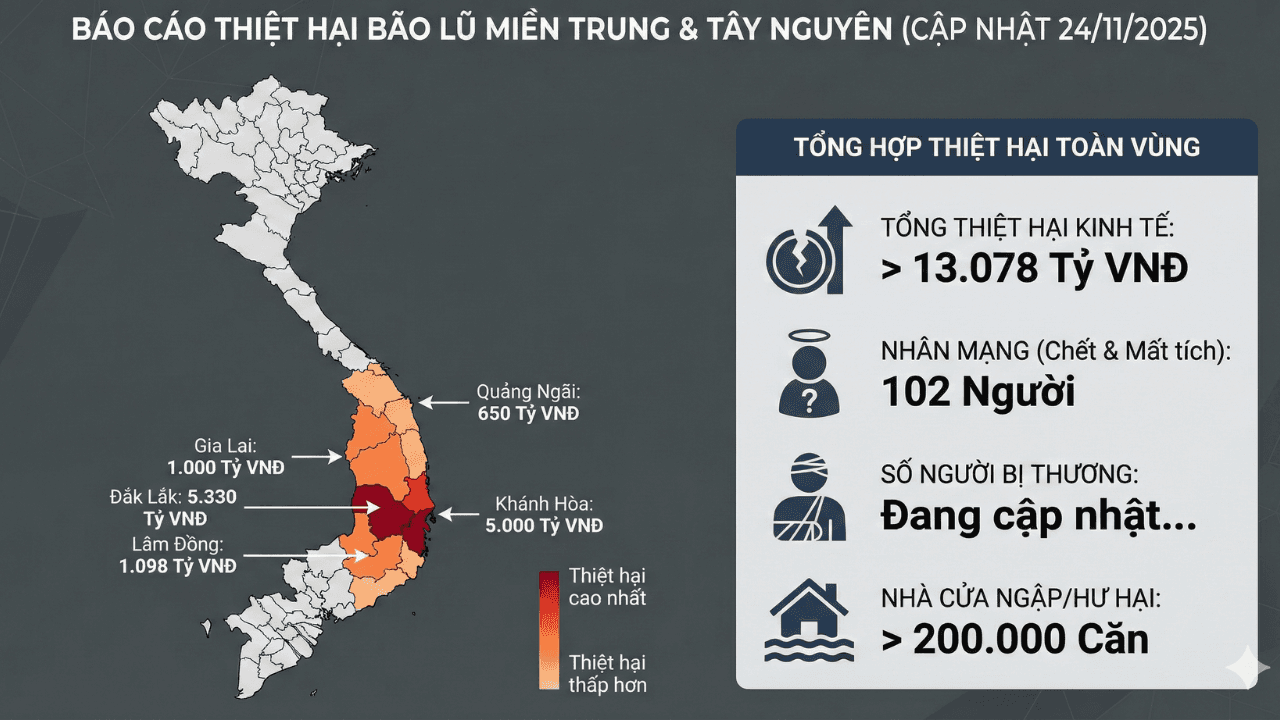
Storm and Flood Damage Report
  • Extremely stable facial and frame consistency: For brand builders or anyone requiring consistency, this feature is essential. The model excels at preserving character face or framing details even when changing backgrounds or outfits. As a result, you can easily create an entire cohesive brand identity.
  • Facial Consistency of Nano Banana Pro
    Facial Consistency of Nano Banana Pro

    Areas where Nano Banana Pro needs improvement

    Despite being impressive, Nano Banana Pro still encounters a few difficulties and minor bugs that need refining:

    • Diagram logic can occasionally be a bit off: Even with Gemini 3's support, generating diagrams or infographics can sometimes get scrambled (for example, step 2 appearing before step 1), despite the high image quality. This error is hard to fix via prompting and usually requires generating from scratch again.
    • Spelling mistakes still occur in text: Every once in a while, the AI still outputs a typo in an image, with an error rate of about 1 in 10. This level is acceptable, but not yet 100% perfect.
    • Image compositing isn't seamless yet: Blending faces into new frames still looks somewhat unnatural, and discerning eyes can spot a slightly fake appearance. Thus, for demanding cases requiring high precision, post-processing by human designers is still necessary.

    How to experience Nano Banana Pro?

    Nano Banana Pro is available to use completely free of charge within the Gemini app.

    • Open the Gemini app (or access it via the web).
    • Select the "Thinking" model. This option is recommended because Nano Banana Pro will leverage Gemini 3's reasoning power to generate images.
    • Select "Create images" under the tools section.

    Free plan users receive a limited usage quota for Pro. Once this quota is exhausted, the system automatically switches back to the original Nano Banana model. Subscribers of higher tier plans (Google AI Plus, Pro, and Ultra) receive significantly higher usage limits for Nano Banana Pro.

    Ultimately, Nano Banana Pro feels like a professional photographer equipped with a 4K camera and a smart processor. It can craft hyper-realistic photos, though it still needs clear instructions regarding logic and intent to ensure the output is not only beautiful, but also makes sense.
    Discussion (0)

    Log in to join the discussion.

    No comments yet. Be the first!

    Related Articles

    Gemini 3.1 Flash-Lite Launches Faster and Cheaper Than Gemini 2.5 Flash

    Gemini 3.1 Flash-Lite: A Fast, Capable, and Affordable Option If you're looking for an AI solution that is both fast and economical for deploying large-scale projects, then Gemini 3.1 Flash-Lite, recently launched by Google, is the answer. This is not just a minor upgrade, but truly a step that makes AI technology more accessible to everyone. Strong Performance at a Manageable Cost What impressed me most about Gemini 3.1 Flash-Lite is how Google balances economic considerations with performance. For those optimizing monthly API costs, this will be a very worthwhile option, especially when popular models like Claude Opus or Claude Code can incur exorbitant costs of up to $200 if you don't want to quickly hit limits. Very Reasonable Price: It only costs about $0.25 per million input tokens. This price allows us to confidently deploy large data processing features without excessive budget concerns. Impressive Response Speed: The feeling of waiting for AI to respond can sometimes be inconvenient, but with Flash-Lite, the speed of the first output is 1.5 times faster than the previous 2.5 Flash version. Although the cost has increased compared to Gemini 2.5 Flash-Lite, it remains reasonable compared to the general market, and the trade-off for speed is truly appreciated by everyone. Built on Gemini 3 Pro Capabilities Despite the "Lite" in its name, don't underestimate its capabilities. Developed based on the Gemini 3 Pro platform, this model still smoothly processes everything from text and images to audio and video. Deep Comprehension: With an Elo score of 1432, Flash-Lite proves it's not inferior to competitors in its segment. Especially, a context window of up to 1 million tokens is perhaps already common for models from Google, which is truly beneficial for those who frequently work with extremely long documents. Flexibility for Developers: Another plus is that you can customize the "depth" of AI reasoning. Depending on whether you're building a simple chatbot or need complex data analysis, you can adjust it for optimal performance. Safety and Reliability Google has also made many refinements to make this model more user-friendly and intelligent in its communication. It minimizes unreasonable question rejections while ensuring strict safety standards, helping everyone feel confident when integrating it into real-world products. Conclusion Overall, Gemini 3.1 Flash-Lite is a very practical step forward from Google. It focuses on exactly what you need: speed, efficiency, and competitive pricing. If you're planning to upgrade your system to reduce tokens for tasks that don't require complex reasoning, give this Gemini 3.1 Flash-Lite version a try!

    Nam
    4 Mar, 2026
    Claude Opus 4.6 Launches, Continues to Emphasize Adaptive Thinking

    Some people may not have even had a chance to experience Claude Opus 4.5, and now Anthropic has already launched Claude Opus 4.6, which is truly an incredibly fast pace. Like its predecessor, Anthropic continues to emphasize the model's transformation from a reactive assistant to a proactive collaborator. The strong changes in how AI understands and accompanies humans in daily work are clearly demonstrated through the Adaptive Thinking feature. [VIDEO:dPn3GBI8lII|Claude Opus 4.6 introduction video|Anthropic's Claude Opus 4.6 introduction video] When Claude Starts Thinking Before Acting The most noticeable change in Claude Opus 4.6 is the Adaptive Thinking feature. Previously, you often had to ponder how long to let the AI think to balance speed and quality.Similar to GPT 5.x, Claude autonomously decides which model to use for a response based on the difficulty of the request. For trivial tasks like renaming files or formatting text, Claude will respond instantly (Low level). But when encountering a complex software architecture problem, it will analyze more deeply before providing the final answer to achieve the highest accuracy. The difference compared to GPT 5.x is that users can still easily intervene with the effort parameter, actively reducing it to a lower level to save time and cost if they find Claude is "overthinking" a simple task. The community is indeed complaining a lot about Claude Opus 4.6 suffering from "overthinking," leading to extremely high token consumption and wasted time; hopefully, Anthropic will quickly address this.Continues to Top the RankingsAnthropic's release of Claude Opus 4.6 with the ability to process 1 million tokens (in beta) puts Claude on par with Gemini 3 and Grok 4.1. However, for regular users, this number is probably not too important as it's very difficult to use up 200k tokens; this feature is mainly for specialized users. Note for Claude Opus 4.6, if the request exceeds 200k tokens, a fee of $10/million input tokens will apply.Immediately after its launch, Claude Opus 4.6 created a widespread "sweep" across global AI rankings. It consistently defeated competitors like Gemini 3, Grok 4.1, and GPT 5.2 to claim the top spot, from agentic programming capabilities on Terminal-Bench 2.0 to complex multidisciplinary reasoning tests like Humanity’s Last Exam.Agents Continue with Autonomous CapabilitiesAnthropic also provides Agent Teams, helping you no longer have to work with a single AI. Especially in the field of coding, Claude Opus 4.5 has gained significant trust for writing code with fewer errors than competitors, and Claude Opus 4.6 will certainly do even better.In large projects, Claude can autonomously divide into small teams working in parallel: one team handles the interface, one team handles system logic, and one team specializes in error checking.A typical example is a team of 16 Claude Agents that autonomously built a C compiler from scratch, generating over 100,000 lines of source code with very little human intervention. Although the cost for these fully autonomous projects can amount to tens of thousands of USD, it opens up a future where AI can manage complex projects from start to finish.Deep Integration into Office: Excel and PowerPointNot stopping at programming, Claude Opus 4.6 has now delved deep into familiar office tools:In Excel: Claude can plan before execution, automatically restructure unstructured data, and handle multi-step changes in a single operation.In PowerPoint: Claude supports creating entire slides from descriptions, understands company layouts, fonts, and design styles to ensure presentations always adhere to brand identity.Safety and Hallucination ReductionDespite being smarter, Claude Opus 4.6 maintains strict safety standards through the Constitutional AI v3 system. This system helps the model achieve its lowest-ever rate of aberrant behavior, scoring only about 1.8/10 in tests for inappropriate conduct.Notably, Opus 4.6 has overcome the weakness of mistakenly refusing valid requests (over-refusals), providing a smoother experience. With the new thinking structure, logic drift in multi-step reasoning chains is also significantly reduced, leading to more stable results in complex tasks such as financial modeling.Conclusion: A Worthwhile Investment?With the price remaining the same as version 4.5, Claude Opus 4.6 is still truly a bargain in the progression towards Agentic AI. However, you should still consider it a smart companion in your work rather than letting it completely replace humans.

    Nam
    11 Feb, 2026
    Google Gemini 3 Released: Next-Gen AI with Advanced Reasoning

    On November 19, 2025, Google officially introduced Gemini 3, its most advanced and intelligent AI model, designed to help users realize every idea. CEO Sundar Pichai declared Gemini 3 as "the best model in the world for multimodal understanding." This model marks an upgrade in the journey towards Artificial General Intelligence (AGI). How is it upgraded compared to Gemini 2.5? Thus, 8 months after the launch of Gemini 2.5, Google has returned with Gemini 3 Pro, featuring upgrades in reasoning and context understanding abilities—it brings together all the capabilities of previous Gemini generations. Sweeping the leaderboards The launch of Gemini 3 Pro, though relatively quiet, was not a giant leap forward yet carried significant weight as it topped numerous LLM leaderboards (such as LMArena, etc.). Of course, compared to Gemini 2.5, Gemini 3 completely surpasses it across all AI benchmarks, such as in identifying the context and intent behind user requests, allowing users to get desired results with fewer prompts. While Gemini 3 outperforming previous-generation Gemini models is expected, its scores also surpassed both Claude 4.5 Sonnet and GPT 5.1. For instance, Gemini 3 demonstrated PhD-level reasoning with a high score of 37.5% on Humanity’s Last Exam without tools—significantly outperforming Claude Sonnet 4.5 (13.7%) and GPT 5.1 (26.5%). Similarly, its GPQA Diamond score (91.9%) continued to lead over Claude Sonnet 4.5 (83.4%) and GPT 5.1 (88.1%). [GEMINI_3_BENCHMARK_CHART] Multimodal power (Multimodality) Gemini 3 continues from Gemini 2.5 with its ability to seamlessly synthesize information across multiple modalities, including text, images, video, audio, and code. Naturally, it performed better on tests than Gemini 2.5, achieving 81% on MMMU-Pro (compared to 68% for Gemini 2.5) and 87.6% on Video-MMMU (compared to 83.6% for Gemini 2.5, according to Google). How is it used in real-world scenarios? In study and research: Gemini 3 can analyze academic papers or long video lectures and generate code for interactive visual diagrams or flashcards. However, when I tested it with a 4-hour video, Gemini 3 in Fast mode couldn't remember everything and either made mistakes or missed details. Therefore, you shouldn't fully rely on the information provided by Gemini 3 just yet; instead, use Notebook LM for those tasks. In creativity and planning: Gemini 3 can translate and convert handwritten recipes in multiple languages into cookbooks perfect for sharing. According to Google, it can even write a poem capturing the physics of nuclear fusion or write code to create visualizations of plasma flow in a tokamak. In sports video analysis: Gemini 3 can analyze sports match videos (such as pickleball, tennis, etc.), identify skills that need improvement, and create training plans. Does Gemini 3 Deep Think have an enhanced reasoning mode? Google also introduced Deep Think mode, an enhanced reasoning mode designed to help solve more complex problems similar to Gemini 2.5, though it actually takes quite a long time to output results. Deep Think mode is currently being tested and is expected to be available soon for Google AI Ultra subscribers in the coming weeks. Therefore, I haven't had the chance to experience it yet, but for regular users, Thinking mode is quite suitable. Developer capabilities and deployment speed How good are Gemini 3's coding capabilities? Gemini 3 performs very well in code generation and handling complex prompts to build richer, interactive web interfaces. However, for coding capabilities, I still trust Claude Sonnet 4.5 more. When Gemini 3 encounters an issue with code, it doesn't stay focused on resolving that specific issue and tends to make more errors as it tries to fix it—unlike Claude Sonnet 4.5, which creates difficulties for people who don't know much about code. In terms of speed, Gemini 3 is significantly faster than Claude Sonnet 4.5 and GPT 5.1 when coding, being twice as fast as Gemini 2.5 for small to medium tasks. To support agent development, Google also released a new agentic development platform called Google Antigravity. It leverages Gemini 3's reasoning and tools to turn AI into a new agent capable of operating independently and proactively. When can you use Gemini 3? Gemini 3 is being rolled out across the entire Google ecosystem starting November 19. In the Gemini chat interface, Google now lets users select Fast, Thinking, and Pro modes instead of selecting LLMs as in Gemini 2.5. This shows that Google is automating the LLM selection process for tasks ranging from simple to complex, similar to what OpenAI did with GPT-5.1. Gemini 3 is also integrated for the first time directly into Google Search via AI Mode. This AI mode uses Gemini 3 to enable new generative user interface (generative UI) experiences, such as vivid image layouts and interactive tools generated based on user queries—a move that, in my personal opinion, is aimed at competing with Open Atlas ChatGPT Atlas and Perplexity Comet.

    Liên
    19 Nov, 2025