Nvidia NemoClaw: the security platform of OpenClaw for enterprises
Quick Summary
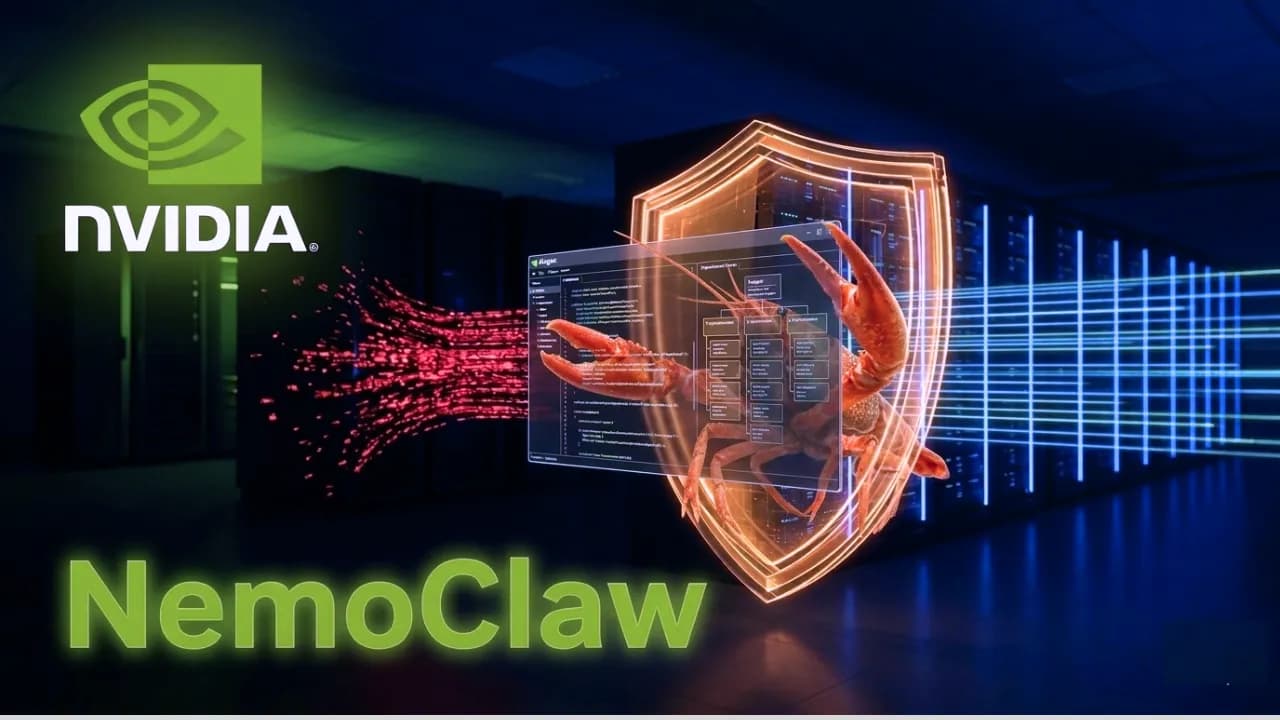
Nvidia shocked GTC 2026 by launching NemoClaw, an enterprise-grade AI agent platform addressing OpenClaw's security flaws. Developed alongside Peter Steinberger, NemoClaw uses OpenShell to prioritize privacy and data security. Nvidia also introduced the new Vera CPU with superior performance for agentic AI, expects $1 trillion in AI chip revenue by 2027, and formed the Nemotron Alliance to drive open-source AI, solidifying its leadership in the AI agent era.
Enterprise IT departments surely ban OpenClaw on internal computers. The reason is not that the tool is ineffective, but because nobody can control what company data flows through it. This is a risk that businesses face when deploying AI agents without a reliable security solution. At GTC 2026, Nvidia answered directly with NemoClaw, a platform built on OpenClaw but adding the entire enterprise-grade security layer that the original version lacked.
What is OpenClaw and why enterprises are hesitant to use it?
If you don't know what OpenClaw is, here is the quickest way to understand: instead of sitting and instructing the AI step-by-step, OpenClaw allows you to create autonomous AI agents that work continuously without your intervention. Developed by engineer Peter Steinberger, who has since joined OpenAI, this platform still grows strongly globally, especially in China, even though tech giants like Gemini and Claude have blocked its API connections.
The problem is that OpenClaw was designed for individuals and small teams, not for enterprises with sensitive data. When incorrectly installed or run with default configurations, the AI agent can access and process internal data without any control layers. Governments in many countries and giants like Google and Anthropic have repeatedly issued security warnings about this issue, which is why most enterprises still stay on the sidelines despite knowing the tool's potential. This is exactly the gap that Nvidia saw and decided to fill.
How NemoClaw solves the security puzzle
Instead of building a brand-new agent platform, Nvidia collaborated directly with Peter Steinberger to develop NemoClaw on the existing OpenClaw foundation. CEO Jensen Huang stated at GTC 2026 that every company needs an OpenClaw strategy, and NemoClaw is Nvidia's way of bringing that strategy into reality safely.
The heart of NemoClaw is an open-source execution environment called OpenShell. Imagine it simply: instead of letting the AI agent run freely across the system like an unsupervised new employee, OpenShell locks it in a separate workspace with rules defined by the business itself. Specifically, OpenShell does three main things:
- Enforces guardrails based on each organization's internal policies, meaning each business decides what the AI agent can and cannot do.
- Keeps AI models running in a separate sandbox environment, preventing them from accessing data beyond their permitted scope.
- Adds data privacy protections before any information is processed, while increasing scalability as demand grows.
What do enterprises specifically gain when using NemoClaw?
Three practical benefits NemoClaw brings compared to using OpenClaw, as provided by Nvidia:
- Data control: The IT department can define exactly which documents and systems the AI agent is allowed to access and what it can do with that data. No more AI agents running wild without anyone knowing what they are reading.
- Flexible AI model selection: Businesses are not locked into a single vendor. NemoClaw supports Nvidia's NemoTron, Anthropic's Claude, OpenAI's GPT, and any other open AI models, allowing cloud model access right on local devices without relying on specific hardware.
- No infrastructure changes needed: NemoClaw runs on top of existing OpenClaw setups, meaning teams currently using OpenClaw can upgrade to NemoClaw without starting over.
NemoClaw is currently in the alpha stage, meaning it is still being finalized before the official launch. Currently, NemoClaw has open-sourced its code on GitHub for those who need higher customization. This is a point to note if you are considering enterprise deployment right now.
What else is notable at GTC 2026 besides NemoClaw?
NemoClaw is just one part of Nvidia's massive wave of announcements at GTC 2026. Other key highlights include:
- Next-generation Vera CPU: Designed specifically for the AI agent era with double the performance and 50% faster speed than traditional CPUs, optimized for complex reinforcement learning tasks.
- $1 trillion revenue forecast: Nvidia expects revenue from Blackwell and Vera Rubin AI chips to reach this level by 2027, reflecting the company's massive bet on the booming AI agent wave.
- Nemotron Alliance: An open collaborative initiative to share resources and computing capacity in the open-source AI domain, drawing the participation of many industry giants.
- Groq 3 and DLSS 5: The Groq 3 language processing unit and DLSS 5 graphics technology were also announced, expanding Nvidia's AI ecosystem beyond agents and into game graphics.
NemoClaw is the bridge bringing AI agents from individuals to enterprises
OpenClaw has proven that AI agents work effectively in practice. The issue is not the technology, but trust—and trust in an enterprise environment comes from control, transparency, and internal policy compliance. NemoClaw does not try to replace OpenClaw, but builds exactly that layer on top of it.
If NemoClaw works as promised when officially released, this could be the key to getting AI agents widely deployed in enterprises, instead of being blocked by IT departments for security reasons. That is precisely the real market Nvidia is targeting.