4AIVN
Back to News

Anthropic Increases Claude Usage Limits After SpaceX Partnership

Published on 8 May, 2026
Anthropic Increases Claude Usage Limits After SpaceX Partnership

Quick Summary

Anthropic officially doubles usage limits for Claude users after reaching an agreement to utilize SpaceX's massive Colossus 1 data center.

Anthropic has just announced a partnership with SpaceX to access over 220,000 NVIDIA GPUs and will immediately use this new computing power to increase usage limits for both Claude Code and API. Here's what's changing and why it matters to users.

Why Did Anthropic Partner with SpaceX?

In recent months, Anthropic has continuously signed large-scale computing agreements with Amazon, Google, Microsoft, and NVIDIA. This time, the company has added another unexpected name: SpaceX.

According to the announcement on May 6, Anthropic signed an agreement to use the entire computing capacity at SpaceX's Colossus 1 data center, equivalent to over 300 megawatts of power and more than 220,000 NVIDIA GPUs. This entire capacity will be put into use within one month and will directly improve the experience for Claude Pro and Claude Max users.

Specific Changes to Usage Limits

Thanks to the new computing resources, Anthropic has implemented three changes effective immediately from the announcement date

Doubling Hourly Claude Code Limits

The 5-hour rate limit for Claude Code is doubled for Pro, Max, Team, and Enterprise plans. If you previously could only run 10 complex Claude Code commands, this is now doubled to 20, which will be significantly helpful. However, it's important to note that the weekly limit remains unchanged, so while increasing the 5-hour limit allows for more intensive work in a short period, it might cause you to hit the weekly cap faster.

Removing Peak Hour Limits

Previously, Claude Code automatically reduced usage limits during peak hours (typically from 9 AM to 3 PM) for Pro and Max accounts. This limit has been completely removed, so users can now use Claude Code at full speed regardless of the time of day.

Significantly Increasing API Limits for Claude Opus Models

The API rate limit for Claude Opus models has been significantly increased. Details of the multiplier increase are published by Anthropic in the following table:
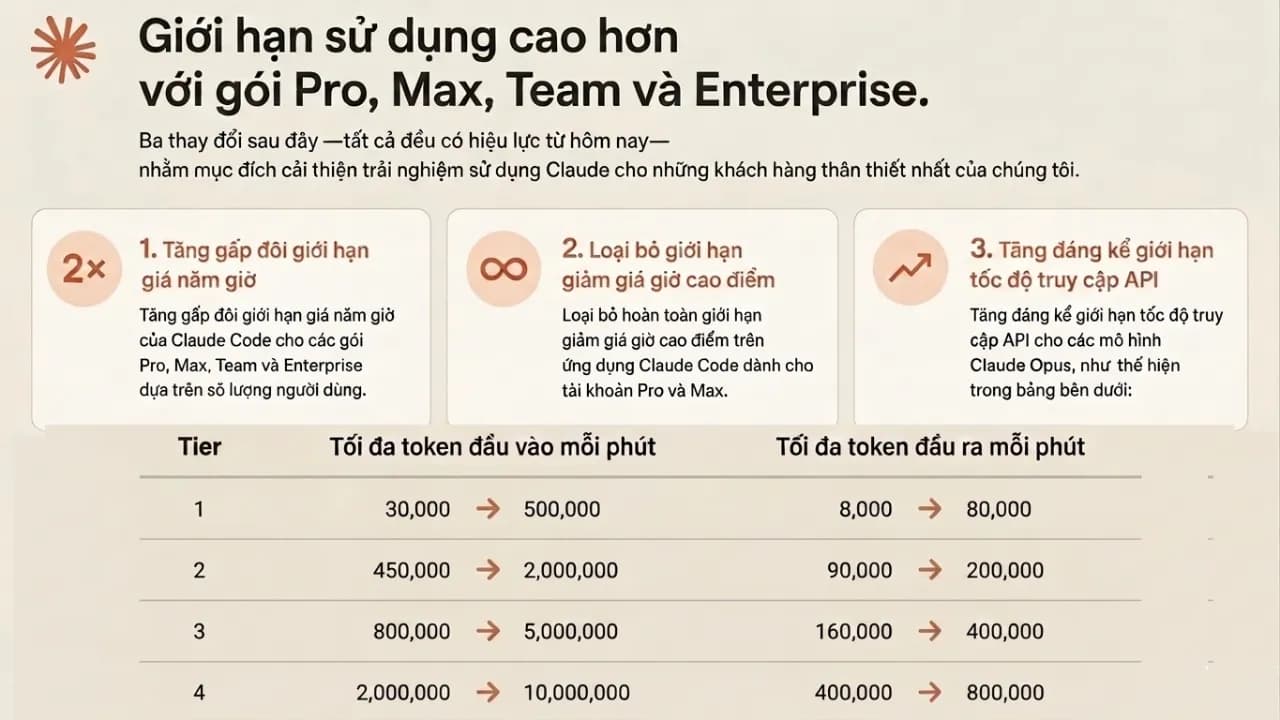
New Claude API rate limit

This change is particularly important for developers building applications on the Claude Code platform

Anthropic's Overall Computing Strategy

The agreement with SpaceX is not an isolated move. In recent months, Anthropic has built a remarkable infrastructure portfolio:

  • An agreement for up to 5 gigawatts with Amazon, with nearly 1 GW operational before the end of 2026
  • A 5 GW agreement with Google and Broadcom, expected to be operational from 2027
  • Strategic partnerships with Microsoft and NVIDIA, including $30 billion in Azure capacity
  • A $50 billion investment in AI infrastructure in the US with Fluidstack
  • And now, over 300 megawatts from SpaceX's Colossus 1 data center

Anthropic runs Claude on various hardware platforms — AWS Trainium, Google TPUs, and NVIDIA GPUs — and states that it continues to seek additional computing power sources.

Expanding to International Markets

A portion of the expanded computing capacity will be used to serve international enterprise customers, especially in sectors requiring local data storage such as finance, healthcare, and government. The agreement with Amazon also includes additional inference capacity in Asia and Europe.

Anthropic also emphasized that it only expands to countries with democratic legal frameworks and secure hardware supply chains, demonstrating a cautious stance amid increasingly fierce geopolitical competition in AI.

What Does This Mean for Claude Users in Vietnam?

From a practical perspective, the three changes to usage limits directly benefit those who use Claude Code daily — especially programmers and individuals who work continuously with Claude Code. The removal of peak hour limits also means that the experience for users in Vietnam (whose time zone often coincides with peak load periods in the US) will be more stable.

In the long term, greater computing power often means the ability to deploy more powerful models at lower costs. This is the foundation for Anthropic to continue competing with OpenAI and Google in the 2026 AI race.

Anthropic is Always Evolving

Anthropic is seriously investing in infrastructure, and the partnership with SpaceX is the latest step in that strategy. The most immediate result users can feel is that Claude Code will be less restricted, and API speeds will certainly improve. In the long run, the computing race among major AI companies promises many more interesting developments in 2026.

Discussion (0)

Log in to join the discussion.

No comments yet. Be the first!

Related Articles

What is an agent harness? The framework that helps AI work efficiently

Imagine having an AI assistant that is incredibly smart but forgets everything between sessions and cannot check the quality of its own work. To solve this problem, developers created a protective management layer around AI models called an agent harness. This is what enables AI agents to complete complex, multi-step tasks autonomously without requiring constant human intervention. What is an agent harness? Think of an AI model as a brilliant new employee with no long-term memory and zero familiarity with the workplace. They can solve complex problems in seconds but will just as easily forget what they were working on, or accidentally send a confidential document to the wrong client. In that scenario, an agent harness acts as the experienced manager sitting right beside them, keeping things on track. Put simply, an agent harness is the software layer wrapping around an AI model that handles all administrative and logistical work so the model itself can focus entirely on reasoning and problem-solving. It connects the AI to external tools, maintains a complete record of work across sessions, and verifies results before considering a task done. In practice, an agent harness handles the following: Connecting the AI model to external tools such as web search, email, and calendars Persisting progress across sessions so the AI never has to start from scratch Filtering out irrelevant information and supplying only the data the AI actually needs at each step Monitoring AI actions to prevent dangerous mistakes Logging activity in detail so humans can audit what happened when needed Origin of the term: The concept of "agent harness" was formally named by technology engineer Mitchell Hashimoto in early 2026. Before that, many development teams had built similar systems but had no shared term for this layer of infrastructure. Why do AI agents fail at long-running tasks? The biggest weakness in today's AI models is the complete absence of long-term memory. Every new conversation starts from zero with no recollection of anything that happened before. Imagine hiring an employee who wakes up every morning having forgotten every agreement, every deadline, and every piece of progress from the day before. When Anthropic tested Claude building a complex web application without harness support, the results were consistently disappointing. Two failure modes kept appearing: The AI tried to do everything at once, ran out of working memory midway through, and left the project unfinished. The next session wasted time trying to figure out what had already been done. The AI declared the task complete without actually running the result to verify it worked. Beyond those two core failures, long-horizon tasks expose three additional problems: Context clog: Accumulated conversation history and tool outputs crowd out the original instructions, causing the AI to gradually lose focus on the actual goal Tool misuse: The AI sometimes searches for information that does not exist or submits incorrect inputs to forms, and without anything to stop it, repeats the same error in a loop Total progress loss on failure: Any network error or system crash wipes out whatever was stored in temporary memory, forcing a full restart Stanford research (2023): AI models tend to overlook information buried in the middle of long text, even when that text is not particularly long. This is why feeding too much data to an AI all at once often backfires without a filtering layer in place. How does an agent harness work in practice? An agent harness operates in two distinct phases to keep work flowing continuously without interruption. Setup phase (runs once) The harness prepares the full working environment before the AI begins: building a structured task list, initializing storage, and recording the starting point. Think of it as the manager drawing up a detailed project plan before handing anything off. This phase only needs to happen once. Execution phase (repeats) Each time the AI begins a new session, the harness automatically reloads all saved progress and assigns only the next relevant task. When the AI wants to take an action such as searching for information or sending a notification, the harness checks whether that request is valid, executes it safely, cleans the returned result, and passes it back to the AI. The model never touches external systems directly without going through this control layer first. The four core components of an agent harness For an AI to operate reliably over extended periods, a standard agent harness needs four essential components: External tool gateway: Allows the AI to interact with the real world by reading documents, searching the web, or sending messages. The harness acts as an intermediary, validating every request before execution and ensuring returned results are clean and usable. Layered memory management: Maintains three types of memory serving different needs: short-term working memory for the current session, a task log recording what has been completed and what remains, and a long-term knowledge store that accumulates across multiple projects over time. Intelligent context filter: Summarizes long conversation histories down to key points and supplies only the data relevant to the current step rather than loading everything at once, keeping the AI focused on the right task at the right moment. Safety checker and human approval gate: Automatically verifies results before marking a task as complete. For sensitive actions such as deleting important data or sending bulk emails, the harness pauses and waits for human confirmation before proceeding. Note on accumulated knowledge: If an AI agent's memory is stored entirely within a closed third-party platform, all the knowledge it builds up over time belongs to that platform. Switching to a different system means starting from zero. This is worth thinking through carefully when choosing a long-term AI agent solution. Harness engineering and the secret behind millions of lines of code Harness engineering is the practice of treating every AI failure as a system problem to fix permanently rather than something to retry or ignore. As Mitchell Hashimoto put it: if the agent makes a mistake, redesign the environment so that mistake becomes physically impossible to repeat. In practice, when OpenAI built large software projects with three engineers producing 3.5 pull requests each per day without typing a single line of code, they had set up automatic verification checks after every AI action. When the AI produced something incorrect, the system returned error messages written in a specific structure so the AI immediately understood what needed to change on the next attempt. Every error message became a learning signal, not just a warning. A study presented at ICML 2025 further confirmed that the same AI model equipped with a harness consistently outperformed itself running without one, even with identical training weights and identical prompts. The environment surrounding the AI matters just as much as the model itself. A telling data point: Anthropic's Claude Code has grown past 512,000 lines of code and continues to expand. More capable models do not make the harness simpler. They make it larger, because there is more capability to orchestrate and more failure modes to guard against. When do you actually need an agent harness? For simple one-off tasks like summarizing a document or answering a specific question, calling an AI directly is perfectly fine. But the moment work extends beyond a single conversation, requires memory from a previous session, or involves multiple steps that need to happen in a specific order, a harness becomes necessary. One thing worth reflecting on: the built-in web search in ChatGPT and Gemini is itself a form of harness. When AI automatically looks something up, there is infrastructure behind the scenes making the tool call, processing the result, and feeding clean information back into context. The harness is invisible to the user but indispensable to the system. Agent harness is not a short-term technical trend. It is the answer to fundamental limitations that AI cannot resolve on its own: no long-term memory, finite working context, and a tendency to misuse external tools without guardrails. 4AIVN has also started applying harness to our own workflows — and what we have found is that it does not just help AI finish tasks. It turns AI into a system that learns from failure and gets more reliable over time.

Nam
1 Jun, 2026
Anthropic launches the highly powerful Claude Fable 5 model

Anthropic just dropped what may be its biggest release yet with Claude Fable 5, and it has quickly become the most talked-about model this week. Not just because of its raw power, but because of how Anthropic brought it to the world: this is the first time a Mythos-class model has been made available to general users, after two months under lock and key for safety reasons. What is Fable 5 and why is it different from previous models? At its core, Fable 5 is not a model built from scratch. It is a "safety-hardened" version of Mythos 5, the most powerful model Anthropic has ever built. Back in April 2026, Mythos Preview was only accessible to a very small group of organizations including AWS, Apple, Google, Cisco, and JPMorgan Chase through Project Glasswing, because its ability to detect and exploit software vulnerabilities was simply too powerful to release broadly. Anthropic had also launched Claude Opus 4.8 beforehand as a stepping stone in the development roadmap toward this new model generation. To get Mythos out the door, Anthropic spent two more months building classifiers running in parallel. These are specialized AI systems that analyze requests before the main model processes them, and when a sensitive topic is detected, the system automatically routes to Claude Opus 4.8 at no additional charge. Anthropic says this mechanism only activates in fewer than 5% of sessions, meaning most general users will notice no difference compared to raw Mythos 5. Fable 5 and Mythos 5 share the same pricing: $10 per million input tokens and $50 per million output tokens, which is less than half the cost of Mythos Preview. Users on Pro, Max, Team, and Enterprise plans can use Fable 5 for free through June 22, 2026. Starting June 23, Anthropic will shift to consumption-based billing until infrastructure capacity allows the model to return to fixed subscription plans. How does Fable 5 differ from Mythos 5 on safety? Despite sharing the same underlying model, Fable 5 and Mythos 5 are two distinct products by design. The difference lies entirely in the safety classifiers layered on top of the base model. Three classifiers Fable 5 has that Mythos 5 does not Fable 5 is equipped with three safety classification layers running alongside the main model, covering: Cybersecurity, Biology and Chemistry, and Distillation. When a user submits a request in any of these areas, Fable 5 automatically falls back to Claude Opus 4.8 instead of the main model, and notifies the user accordingly. Mythos 5 has none of these filters. It retains the full software exploitation and biological research capabilities that Anthropic considers too dangerous for wide distribution, which is why Mythos 5 remains restricted to a limited group within Project Glasswing, including vetted cybersecurity professionals, critical infrastructure organizations, and approved biology researchers. How does this affect real-world performance? The classifier difference leads to meaningfully different benchmark results in specialized tasks. On ExploitBench, a benchmark focused on cybersecurity, Mythos 5 scores 78% while Fable 5 lands near the 40% range of Opus 4.8, because the fallback mechanism triggers as soon as it detects attack-related requests. For scientific research, Mythos 5 can design proteins and generate novel hypotheses at roughly 10 times the speed of previous methods, while those same capabilities are restricted in Fable 5 for safety reasons. If you are a researcher or work in legitimate cybersecurity, be aware that Fable 5 may automatically redirect some of your requests to Opus 4.8, even when the context is entirely valid. Anthropic acknowledges this and is actively working to improve classifier accuracy. Real-world performance: what do the numbers say? On SWE-Bench Pro for coding tasks, Fable 5 scores 80.3%, compared to 69.2% for Opus 4.8 and 58.6% for GPT-5.5. But perhaps the more striking number comes from a real deployment: Stripe used Fable 5 to migrate an entire 50-million-line Ruby codebase in a single day, a task that would have taken a full engineering team more than two months to complete manually. On business analytics, Fable 5 is the first model to cross the 90% threshold on Hex's complex analytics benchmark, outperforming Opus 4.8 by 10 percentage points. IMC, a quantitative trading firm, reported that the model scored near-perfect on their internal evaluation covering fact lookup, causal reasoning, and expected value calculations. The biggest shift from previous models is the ability to sustain focus across multi-day tasks without needing human oversight at every step. Rather than executing commands one at a time, Fable 5 can take on a large project, self-plan, run tests, and handle errors in a loop, behaving far more like an engineer than a question-answering tool. Fable 5 is now available on the Claude API under the model ID claude-fable-5, with support on Amazon Bedrock and Google Vertex AI for enterprise consumption-based plans. Notion integrates Fable 5: from scattered notes to a complete action plan Notion is one of the first applications to integrate Fable 5, and the reason is straightforward. The tasks Fable 5 handles best, specifically reading multiple fragmented data sources, synthesizing them, and producing a logical structure, are exactly what Notion users need most in their daily work. Simon Last, co-founder of Notion, described the primary use case as turning messy meeting notes into a task board with assignments and priorities. Instead of users having to re-read entire transcripts, summarize, and manually create tasks, Fable 5 handles the entire chain without needing to be prompted at each step. There has been no official announcement from Notion about Fable 5 pricing after June 22. It remains to be seen whether Notion AI will pass the consumption cost directly to users or absorb it into existing subscription tiers. If the rate ends up lower than going directly through Anthropic, that would be a meaningful advantage for Notion subscribers. A few things to keep in mind before diving in Fable 5 is powerful, but there are two things worth considering before building it into your workflow. First, the $50 per million output tokens price point is high relative to the current market, making it well-suited for complex engineering or analytical tasks but not necessarily for simpler jobs that Sonnet or Haiku can handle at a fraction of the cost. Second, the safety classifiers work well in the vast majority of cases but can trigger incorrectly in some legitimate research contexts, something Anthropic openly acknowledges and is continuing to refine. For individual users on Pro or Max plans, the remaining days before June 22 are a reasonable window to evaluate whether Fable 5 actually generates enough value at that price point before committing to pay-per-use billing.

Nam
10 Jun, 2026
Claude Code self-orchestrates work with Dynamic Workflows

Thariq Shihipar's post from the Claude Code team at Anthropic has drawn significant attention in the AI user community. He revealed Dynamic Workflows, a feature that allows Claude to design its own workflows instead of just waiting for commands, and this is considered the most important upgrade since Claude Code gained skills and subagents. This feature uses the harness concept as its foundation to handle technical requirements. Three fatal errors that cause AI agents to fail at complex tasks Before discussing the solution, Thariq points out an uncomfortable reality: most AI agents today face serious problems when handling complex, multi-step tasks within a single context window. He categorizes them into three core failure modes that nearly every agent system encounters. Agentic laziness: when AI declares done after finishing only half the work This is the phenomenon of Agentic Laziness, where an agent completes part of the work and then self-reports as finished. A specific example: you ask an agent to review 50 code files, but it only looks through 20 files and concludes that everything is fine. The cause lies in context window limitations, and when the amount of information is too large, the agent tends to take shortcuts to finish faster. Will an agent be biased toward itself? An agent being biased toward itself is called Self-Preferential Bias, and this occurs when you ask an agent to review its own results. Like asking a student to grade their own exam, the agent tends to favor the results it already produced, leading to uncritical validation and overlooking potential errors. This is particularly dangerous in tasks requiring high accuracy. How to prevent an agent from losing its original intent step by step Goal Drift is the phenomenon where an agent gradually forgets its original goal after many processing steps or after context compaction. Specific constraints like "don't do X" or important edge cases can be dropped when memory is summarized, so the final result deviates from the original requirement without the agent ever realizing it. Dynamic Workflows helps Claude write its own work orchestration framework Anthropic's solution is not to make the model smarter, but to change how Claude organizes work. Dynamic Workflows transforms Claude from a code-writing agent into an agent that designs operational workflows for complex tasks. The core concept here is self-organization: Claude can analyze goals on its own, choose the appropriate working mode, and create an internal workflow before starting execution. Custom harness instead of a fixed workflow Instead of operating within a fixed environment, Claude writes a harness framework in JavaScript designed specifically for each task. This harness acts like a project manager: it breaks down the work, initializes specialized sub-agents for each part, assigns appropriate tools, routes work to different models, and performs adversarial verification to ensure quality. How does a harness work? To understand more clearly, imagine the harness as a theatrical script that Claude writes for itself before performing. When given a complex task, Claude does not dive straight in but pauses to write a JavaScript snippet describing the entire workflow: how many sub-agents are needed, what each agent does, what order things happen in, and how results from one agent are passed to the next. A concrete example: if you ask Claude to audit 1,000 Slack messages to find recurring incidents, the harness might look like this logically: Agent 1 (classification): reads all messages and assigns labels by topic Agent 2, 3, 4 (parallel processing): each agent deeply analyzes one topic group Agent 5 (synthesis): collects results from the three agents above and removes duplicates Agent 6 (cross-check): re-reads the synthesized results and provides independent critique The important point is that Claude writes this harness based on the specific characteristics of each task, not according to a rigid template. Different tasks produce different harnesses, and that is exactly why this feature is called "dynamic." The harness is written in JavaScript and runs within the Claude Code environment. You can activate Dynamic Workflows by saying "use a workflow," however this phrase is easily confused with regular workflows, so it is recommended to use the keyword "ultracode" in your prompt to clearly distinguish between a regular workflow and a Dynamic Workflow and save more tokens. Context isolation to prevent context degradation One of the smartest design choices in Dynamic Workflows is the Isolation feature. Each sub-agent is given its own separate context window, completely independent from other agents. This prevents the phenomenon of context rot, meaning the quality degradation that occurs when a context window becomes overloaded, while also eliminating both Agentic Laziness and Goal Drift since each agent focuses only on its assigned piece of work. Six reusable orchestration patterns Claude can combine six available orchestration patterns to handle a wide variety of situations: Classify and act: classifies input then selects the appropriate action Fan out and synthesize: splits work into multiple parallel branches then synthesizes the results Cross-check verification: uses a separate agent to cross-check results Generate and filter: generates multiple options then filters for the best one Tournament: puts options into direct head-to-head elimination rounds Loop until done: repeats until a quality threshold is reached Can you optimize costs when using Dynamic Workflows? Running multiple sub-agents in parallel might sound expensive, but Dynamic Workflows is actually designed to optimize costs in several specific ways. Smart routing to the right model Not every step in a workflow needs the most powerful model. The harness allows Claude to route each task to a model that matches its complexity: simple classification steps can run on smaller, cheaper models, while only steps requiring deep reasoning need a large model. The result is that total costs are often lower than running the entire workflow on a single model. Context isolation helps reduce token consumption Because each sub-agent only receives the portion of context it actually needs for its work, total token consumption across the entire workflow is often significantly lower compared to the traditional approach, where the full conversation history gets stuffed into a single context window that keeps growing larger. Avoiding rework through early checkpoints The harness can install quality checkpoints between steps. If a step produces a result that does not meet requirements, the system stops and reprocesses just that step rather than running the entire workflow to completion before discovering an error at the end. This approach saves significant costs for long multi-step tasks. If you are concerned about costs, start with moderate-volume tasks to observe actual token consumption before scaling up. What are the real-world applications of Dynamic Workflows? What excites Thariq most is not the coding capability, but the way Dynamic Workflows extends Claude Code into non-technical tasks. The feature can be activated with natural language (for example: "use a workflow") or the keyword "ultracode." Real-world applications include: Auditing thousands of Slack messages to find recurring incidents Systematically ranking and screening large candidate pools Running automated live elimination tournaments to choose the best name for a CLI tool Handling high-precision operational tasks that previously only humans could perform The design philosophy is architectural constraints rather than raw intelligence The most notable aspect of Anthropic's approach is the design philosophy: rather than trying to increase the raw intelligence of the model, they build architectural constraints into the workflow. In other words, instead of hoping the model will naturally know how to avoid mistakes, they design the system so that errors are hard to occur in the first place, and the harness is the tool that enforces that philosophy. Dynamic Workflows shows that the next step forward for AI agents does not lie in smarter models but in the ability to design workflows on their own. Just as a good manager divides work among a team rather than doing everything alone, Claude can now organize its own team of sub-agents, and this is a clear signal that the future of AI coding is no longer just about writing code faster but about organizing work better.

Nam
5 Jun, 2026
Claude Opus 4.8 launches: what is new in Anthropic's strongest model?

Anthropic has introduced Claude Opus 4.8, a release the company describes as its strongest generally available model. The update is not only about stronger reasoning for complex work; it also adds practical changes for developers building AI agent, coding assistants, and long-running automation workflows. The important point is that Claude Opus 4.8 is not just a renamed Opus 4.7. Anthropic is focusing on three practical areas: more stable long-context handling, more reliable tool use, and better cost control in agent loops. With the model ID claude-opus-4-8, it is already available for Claude API and supported cloud platforms. What is Claude Opus 4.8? Claude Opus 4.8 is targets multi-step reasoning, long-running agentic coding, and work that requires a higher level of autonomy. According to Anthropic's documentation, the model supports a default 1 million token context window on Claude API, Amazon Bedrock, and Google Vertex AI, while Microsoft Foundry supports 200,000 tokens. The model also supports up to 128,000 output tokens, adaptive thinking, and the same core tool capabilities as Claude Opus 4.7. This means teams already using Opus 4.7 can likely test the upgrade with limited changes, but they should still review behavior shifts and API constraints before moving production traffic. Key new features Claude Opus 4.8 introduces several updates that directly affect prompt design, long conversation management, and API cost optimization. These are especially relevant if you run deep chatbots, coding assistants, or multi-step agents. System messages during a conversation One major change is support for adding a message with role: "system" after a user turn in the messages array, as long as Anthropic's placement rules are followed. This lets developers update instructions during a long conversation without resending the entire original system prompt. In practice, this is useful for agents that run through many steps. Instead of breaking prompt cache efficiency by repeating a large instruction block, an application can add new instructions at the right moment, preserve cache for prior conversation context, and reduce input cost across long workflows. Fast mode for Claude API Anthropic is also bringing fast mode to Claude Opus 4.8 as a research preview on Claude API. By setting speed: "fast", users can receive higher output token throughput, with Anthropic describing speedups of up to 2.5 times under supported conditions. Fast mode is especially useful for products that need lower latency while staying on the same powerful Opus model. However, the documentation also notes that this mode carries premium pricing, so engineering teams should reserve it for high-value paths or workflows where response speed clearly matters. Prompt caching becomes easier to use With Claude Opus 4.8, the minimum prompt size for caching drops to 1,024 tokens. This small change has a practical impact: many prompts that were previously too short to create a cache entry on Opus 4.7 can now be cached without code changes. For products with stable system prompts, long internal documentation, or repeated API calls, prompt caching can reduce cost significantly. Combined with mid-conversation system messages, Claude Opus 4.8 is better suited for agents that need to preserve state across many steps. Documented refusal stop details Anthropic has also documented the stop_details object for refusal responses. When the model cannot complete a request, the application can receive not only a refusal stop reason but also more structured information about why the refusal happened. This helps products handle the user experience more gracefully. Instead of showing a generic error, an application can distinguish different refusal categories and guide users toward a more appropriate next step. API constraints to watch Although Anthropic says these constraints carry over from Claude Opus 4.7 and are not breaking changes for code that already works with the previous model, developers should still check them carefully. On the Messages API, Claude Opus 4.8 does not support non-default values for temperature, top_p, or top_k. Passing these sampling parameters will return a 400 error. Another point is that adaptive thinking is the only supported thinking mode. Older configuration patterns that set a fixed thinking token budget are no longer the right approach for Opus 4.8. Anthropic recommends using thinking: {"type": "adaptive"} and controlling reasoning depth through the effort parameter. On Claude Opus 4.8, the default effort is high across all surfaces, including Claude API and Claude Code. If an application already sets effort explicitly, the current configuration remains in place; if not, the default behavior may differ from prior expectations and should be tested. Why it matters for coding agents and long workflows Anthropic says Claude Opus 4.8 targets improvements in long-running coding agents, including better long-context handling, less frequent compaction, and stronger recovery after compaction. These are hard problems for large models: after many rounds of reading files, editing code, running tests, and summarizing state, agents can lose focus or miss important details. The new model is also optimized to trigger tools at the right time more reliably. For systems that need to call search, databases, terminals, browsers, or internal APIs, fewer missed tool calls can make a large difference in reliability. This matters more than a single benchmark score because real agent quality depends heavily on knowing when to use the right tool. Should you upgrade to Claude Opus 4.8? If you already use Claude Opus 4.7 for complex reasoning, programming, or autonomous agents, Opus 4.8 is worth testing early. Changes such as the 1 million token context window, lower prompt caching threshold, and mid-conversation system messages all target real production problems, not only short prompt quality. Still, engineering teams should not upgrade blindly. Review sampling parameters, thinking configuration, default effort expectations, and cost implications if you plan to use fast mode. For products handling sensitive data or critical workflows, run an A/B test on representative tasks before moving all traffic to Claude Opus 4.8. Conclusion Claude Opus 4.8 shows that Anthropic is putting more weight behind the agent and developer market. The improvements are not only about reasoning quality; they also cover operational details such as caching, mid-conversation system messages, output speed, and refusal classification. For teams building serious AI products, this is a release worth watching because it addresses real deployment issues in long-term AI applications.

Nam
29 May, 2026